Platform
Learned LLM router
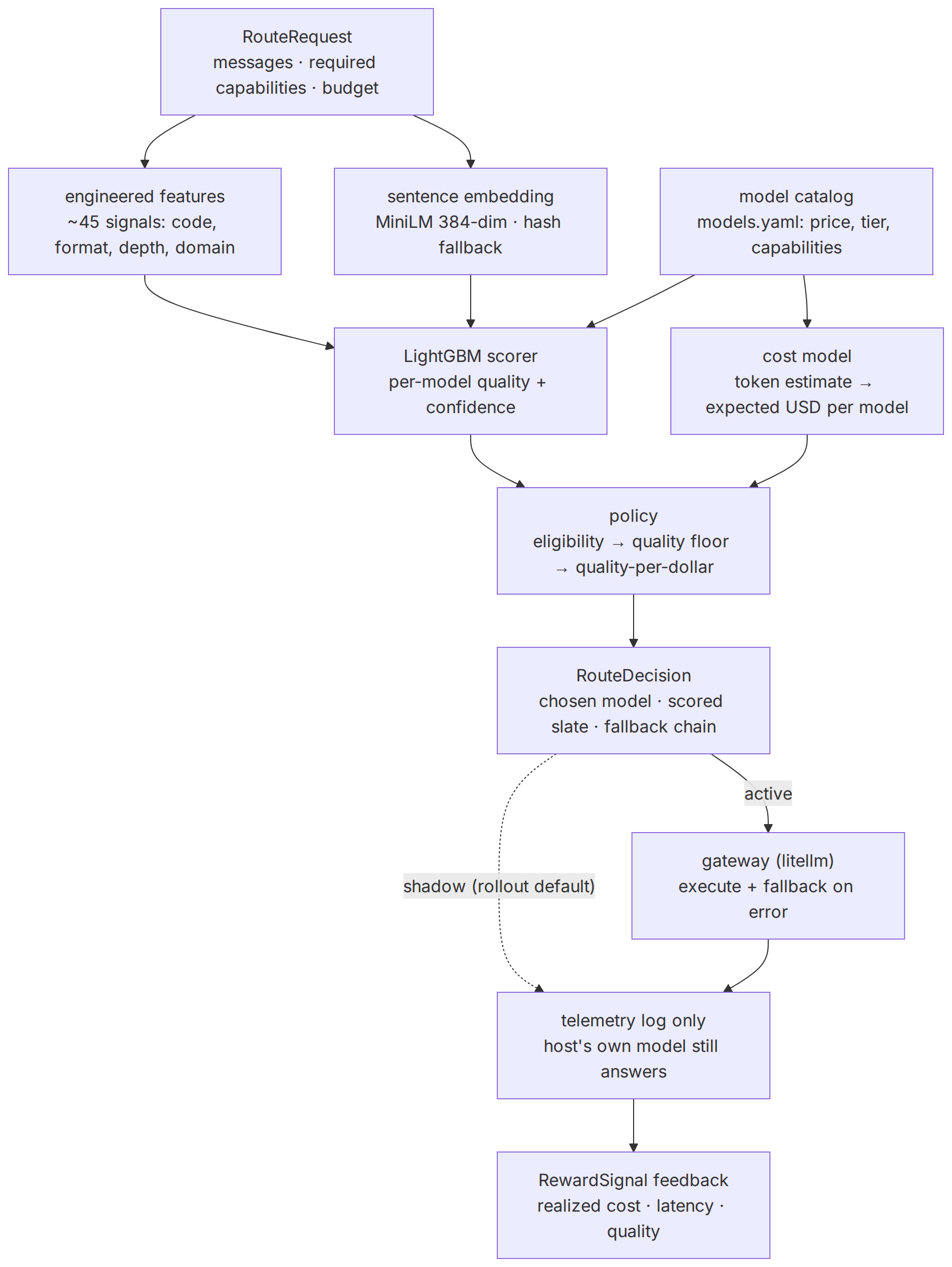
Multi-provider AI answers which providers a workspace may use; it does not answer which model this request deserves. A frontier model on a one-line summarization burns money; a cheap model on a hard reasoning chain burns quality. The learned LLM router is an optional sidecar (services/llm-router, Python + FastAPI) that closes that gap: for each request it predicts the quality score every catalog model would earn, estimates each model's dollar cost, and picks the model that maximizes quality-per-dollar subject to a quality floor. Published routers (RouteLLM, RouterBench) support 35–85% cost reduction at near-quality-parity — but the router treats that as a claim to benchmark, not a promise.
Optional, and off by default
LLM_ROUTER_MODE (default off). Off means the sidecar is never contacted and the host's model resolution is byte-for-byte unchanged. The rollout mode is shadow — the router is consulted and logged but the status-quo model still answers — and active is reserved until a week of shadow metrics validates on real traffic. In every shipped mode the router sits outside the answer critical path: a router timeout or crash never delays or fails a user answer.How a request becomes a decision
LLM model routing
request → features + embedding → per-model scoring + cost → policy → decision. The dotted edge is shadow mode, the rollout default: the decision is logged next to the model the host actually used, and realized cost/latency/quality flow back as RewardSignal feedback either way.
Downloads

Concepts
- LLM router
- Router
Keywords
- models.yaml: price, tier, capabilities
- engineered features
- sentence embedding
- LightGBM scorer
- model catalog
- cost model
- rollout default
- gateway (litellm)
- RewardSignal feedback
- messages · required capabilities · budget
- ~45 signals: code, format, depth, domain
- MiniLM 384-dim · hash fallback
- per-model quality + confidence
- token estimate → expected USD per model
- chosen model · scored slate · fallback chain
- shadow (rollout default)
- execute + fallback on error
- realized cost · latency · quality
- eligibility → quality floor → quality-per-dollar
- RouteRequest
- policy
- RouteDecision
- active
Source and generation provenance
Status: current
Generated at: 2026-08-12T23:39:59.243Z
Source hash: 631e93d71b118dd16c0fe9b0407201f6baff19e073a452abd1e7e431cd6611e5
Metadata payload hash: 16b35333e0893dd869dca87980737f1b0306b4005da2174d29ecc3eeac75f57b
Canonical appearance
src/app/(docs)/docs/concepts/llm-router/page.tsx:27 route /docs/concepts/llm-router
All appearances
canonical—src/app/(docs)/docs/concepts/llm-router/page.tsx:27route/docs/concepts/llm-router
No mirrored appearances.
Generation versions
App: eli-ai 0.1.0
Mermaid: 11.16.0 · Mermaid CLI: 11.16.0
Node: v26.3.1 · Yarn: 4.17.1
Renderer config hash: 68c10966fe84406ee626034d58bfabd555df9f65f691204b7c46db24038da101
Renderer theme hash: c80287a78d80ad63d27bd5ca348b2ef9a7e2f44da289e436be6484ea28a1b033
Adapter versions: diagramGenerator=2, drawioFlowchart=1, drawioGantt=1, drawioSequence=1, drawioState=1
Full sidecar JSON: llm-model-routing-631e93d7.json
Each candidate model is an arm. The scorer is one LightGBM regressor over [MiniLM embedding (384) ⊕ ~45 engineered features ⊕ model one-hot] trained to predict the judge score that model would earn on the query — so scoring a slate is one feature computation plus N cheap forward passes, sub-millisecond on CPU. The engineered features read the request directly: token counts, fenced code blocks, structured-output demands (JSON/table/schema), conversation depth, math symbols, language, question type, required capabilities. Before any training artifact exists, the scorer falls back to documented static tier priors, so the router works out of the box and reports itself as scorer: "heuristic" on /health.
The policy: quality-per-dollar under a floor
- Eligibility first.A model must cover the request's required capabilities (vision, tools, JSON mode) and fit any
max_cost_usdbudget. If that leaves nothing, the router returns the safe default rather than no answer. - The floor always applies. Only models whose predicted quality clears
0.62are considered. The floor is deliberately conservative, because over-aggressive cheap routing is the classic router failure mode. If nothing clears it, the router takes the highest-quality eligible model — it never silently settles. - Then maximize quality-per-dollar among the models that cleared the floor. That is the default objective, and the reason a mid-tier model routinely beats both the frontier model (which costs far more for a marginal quality gain) and the cheapest one (which fails the floor).
- A per-request
min_qualityflips the objective. Set it and the router switches to cheapest model clearing that bar— the "I need at least this good, spend nothing extra" mode. - Low-confidence escalation. Confidence is the margin between the top two predicted qualities; below
0.05the router escalates to a safe mid-tier default rather than guessing between near-ties. - Fallback chain. Every decision carries up to three next-best eligible models, so the execution gateway can cascade on API errors, timeouts, or refusals.
The catalog itself is declarative — config/models.yamllists each model's provider, litellm string, per-token prices, tier, and capabilities. Adding a model is a config edit plus a golden-set re-run; no code changes.
Trained offline, measured like a benchmark
There is no live traffic to learn from on day one, so the scorer bootstraps from a 2,000-example golden set stratified over ~15–18 task classes: every enabled model answers every query, a frontier judge (from a different model family, with verbosity and position bias mitigations, every judgment cached) scores every answer, and verifiable classes use free programmatic grading instead. The one-time bill is roughly $50–150, fully cached. The trained router is then judged as a curve: sweeping willingness-to-pay traces its cost-quality Pareto frontier against always-frontier, always-cheapest, random, and a keyword-heuristic baseline — with bootstrap confidence intervals, and acceptance gates including ≥30% cost reduction at quality parity with always-frontier and <50 ms p95 router overhead. This mirrors how evals gate the rest of the platform: no metric, no rollout.
Shadow-first integration
In shadow mode the host asks the router what it would have picked — a fail-soft POST /route started before generation and capped at 800 ms, so it scores concurrently with the answer and can never delay or fail it. The would-have-been decision is logged next to the model that actually answered. Once the answer resolves, the host reports a RewardSignal to POST /feedback: the model used, the realized cost, and an implicit quality reward derived from the answer's groundedness and policy verdict. A week of that yields routing mix, predicted-vs-realized quality, and would-have-saved cost before any user-facing change — and it is exactly the Phase 2 substrate: a contextual bandit, warm-started from the supervised scorer, learns from rewards the shadow phase is already collecting.
Where it lives
route · serve · build-golden · run-models · judge · train · benchmark), catalog, budget notes, and acceptance gates are documented in services/llm-router/README.md. Provider selection and workspace model slots stay where they are — Multi-provider AI — and the router never bypasses a workspace's provider allowlist. Cost visibility for everything else is in Cost & schedules.