JavaScript & React SDK
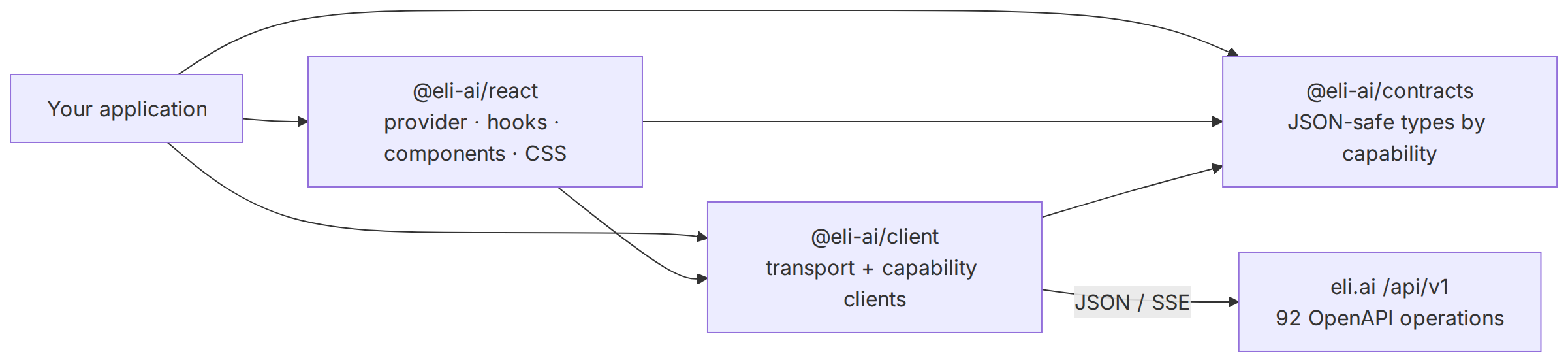
eli.ai's package family separates wire contracts, a headless HTTP client, and React UI. You can use only JSON types, drive every public API operation from a server, or embed complete capabilities in a React application without importing Next.js.
Implemented in the repository
@eli-ai/contracts, @eli-ai/client, and @eli-ai/react are implemented as version 0.1.0 workspace packages. A public package-registry release is a separate distribution step, so confirm your registry before using the install commands below. The OpenAPI reference remains the wire source of truth.Three layers, one wire contract
SDK package dependency graph
React builds on the headless client; the client builds on JSON-safe contracts; all server authority remains in /api/v1.
Downloads

Concepts
- Package graph
- SDK
Keywords
- JSON / SSE
- Your application
- JSON-safe types by capability
- transport + capability clients
- provider · hooks · components · CSS
- eli.ai
- @eli-ai/contracts
- @eli-ai/client
- @eli-ai/react
- /api/v1
Source and generation provenance
Status: current
Generated at: 2026-08-12T23:42:02.967Z
Source hash: 8bbd725c00ac74564f2011484ebd2ce99acd8234cdc6a9370111f7cf1d155ef4
Metadata payload hash: b9b35205a36b230ba5ef37ae1b38408b3933bfee88d244dd18ea0de933e19c92
Canonical appearance
src/app/(docs)/docs/api/sdk/page.tsx:24 route /docs/api/sdk
All appearances
canonical—src/app/(docs)/docs/api/sdk/page.tsx:24route/docs/api/sdk
No mirrored appearances.
Generation versions
App: eli-ai 0.1.0
Mermaid: 11.16.0 · Mermaid CLI: 11.16.0
Node: v26.3.1 · Yarn: 4.17.1
Renderer config hash: 68c10966fe84406ee626034d58bfabd555df9f65f691204b7c46db24038da101
Renderer theme hash: c80287a78d80ad63d27bd5ca348b2ef9a7e2f44da289e436be6484ea28a1b033
Adapter versions: diagramGenerator=2, drawioFlowchart=1, drawioGantt=1, drawioSequence=1, drawioState=1
Full sidecar JSON: sdk-package-dependency-graph-8bbd725c.json
@eli-ai/contractsFramework-free request, response, error, and SSE event types through capability subpaths.
@eli-ai/clientA standards-based Fetch client covering all 92 current operations, including authenticated SSE.
@eli-ai/reactAn injected provider, generic async hooks, complete capability components, and an optional CSS export.
Headless client
The client accepts a deployment origin, a credential resolver, a workspace resolver, and an injectable Fetch implementation. Dates stay ISO strings, currency stays a decimal string, and route-specific response envelopes stay intact.
Capability subpaths
Contracts are imported by grouped capability, so a document integration does not need React or agent stream types. The contracts root deliberately re-exports only shared metadata (common, auth, capabilities, and operations); payload contracts use explicit subpaths. Stable paths are /common, /auth, /query, /documents, /graph, /governance, /data, /agents, /quality, /reports, /connectors, /capabilities, and /operations.
Authentication and workspace selection
The client adds protocol headers; it does not make an authorization decision. The server still resolves the key, checks the operation's scope, narrows user keys against the owner's live workspace role, and runs tenant reads and writes beneath FORCE row-level security.
SDK authentication boundary
The SDK transports identity; the server remains the trust boundary.
Downloads


Concepts
- Auth flow
- SDK
Keywords
- FORCE RLS
- eli_sk_ or eli_uk_
- injected fetch
- Bearer key
- scope + live capability
- workspace transaction
- /api/v1
- Application
- EliTransport
- optional
- X-Workspace-Id
Source and generation provenance
Status: current
Generated at: 2026-08-12T23:41:59.195Z
Source hash: ed41851a1721220d89d202e25c1b11c75950f72020311ecc83f02e6c0810fb43
Metadata payload hash: 9d0bcbfd3bbd81b41bd9c5ce77a000de52259b38907e407314b19cf02b978f35
Canonical appearance
src/app/(docs)/docs/api/sdk/page.tsx:39 route /docs/api/sdk
All appearances
canonical—src/app/(docs)/docs/api/sdk/page.tsx:39route/docs/api/sdk
No mirrored appearances.
Generation versions
App: eli-ai 0.1.0
Mermaid: 11.16.0 · Mermaid CLI: 11.16.0
Node: v26.3.1 · Yarn: 4.17.1
Renderer config hash: 68c10966fe84406ee626034d58bfabd555df9f65f691204b7c46db24038da101
Renderer theme hash: c80287a78d80ad63d27bd5ca348b2ef9a7e2f44da289e436be6484ea28a1b033
Adapter versions: diagramGenerator=2, drawioFlowchart=1, drawioGantt=1, drawioSequence=1, drawioState=1
Full sidecar JSON: sdk-authentication-boundary-ed41851a.json
Workspace selection is deterministic: a headless method's per-call workspaceIdoverrides the client transport default. React hooks and components pass the provider's workspace as that per-call override when supplied; otherwise the injected transport's default applies. An explicit x-workspace-id custom header takes final precedence, so do not pass untrusted arbitrary headers through an integration wrapper.
| Key | Workspace rule |
|---|---|
| eli_sk_… | Fixed to one workspace. A different X-Workspace-Id is rejected. |
| eli_uk_… · one workspace | The single allowed workspace is selected automatically. |
| eli_uk_… · multiple/all | Every request must include X-Workspace-Id inside the key grant and live membership. |
Do not put a workspace key in browser code
eli_sk_ key in a bundle, HTML, local storage, or public runtime configuration. The current API also installs no cross-origin CORS policy. Browser React consumers should use a same-origin server-side BFF or reverse proxy that injects a Bearer key. A shared origin alone does not reuse the application session: /api/v1 still returns 401 without a Bearer credential. Direct browser use is only appropriate for a narrowly scoped user credential under an operator-controlled setup. The injected transport/custom Fetch is the trust boundary.Durable runs over Fetch-based SSE
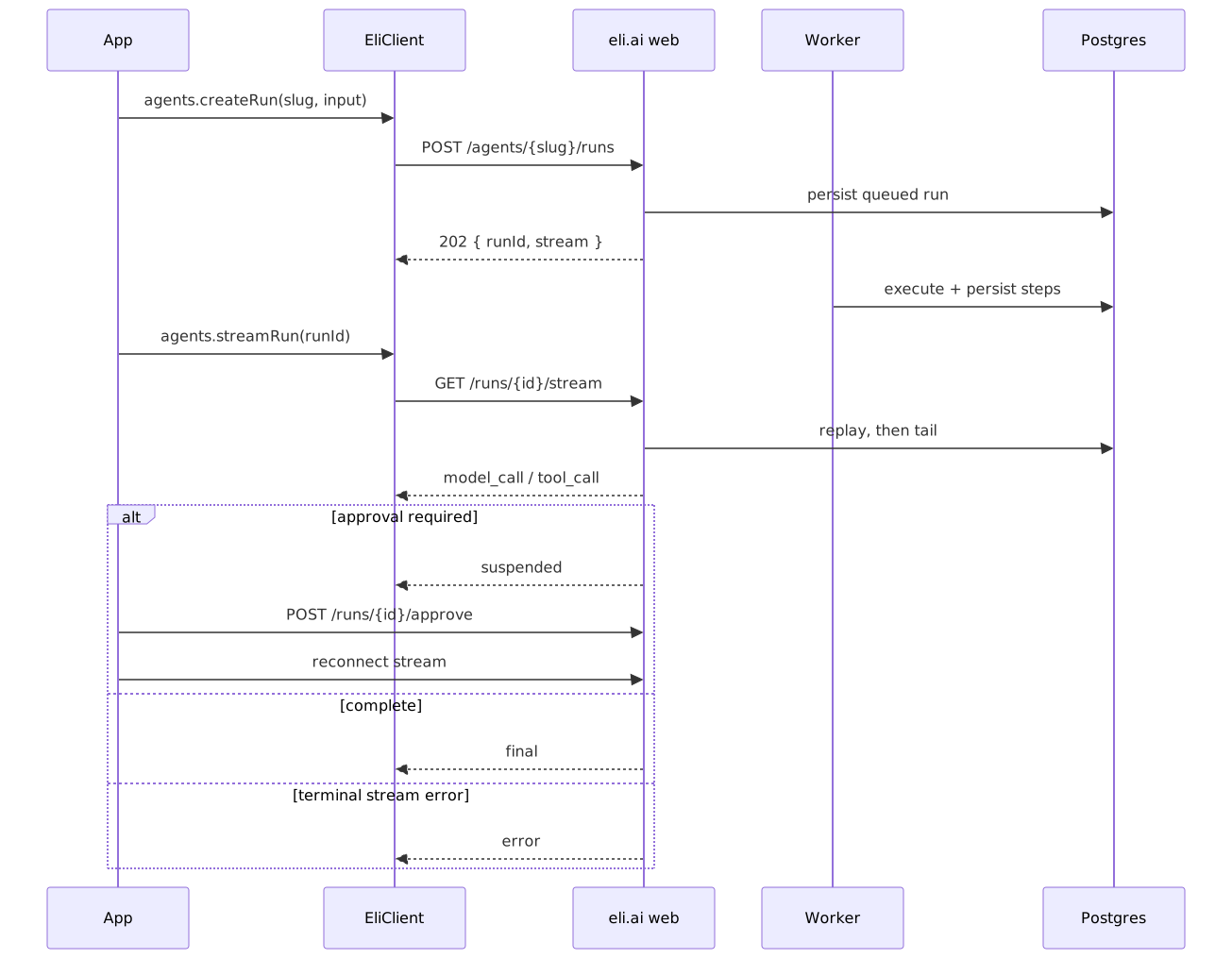
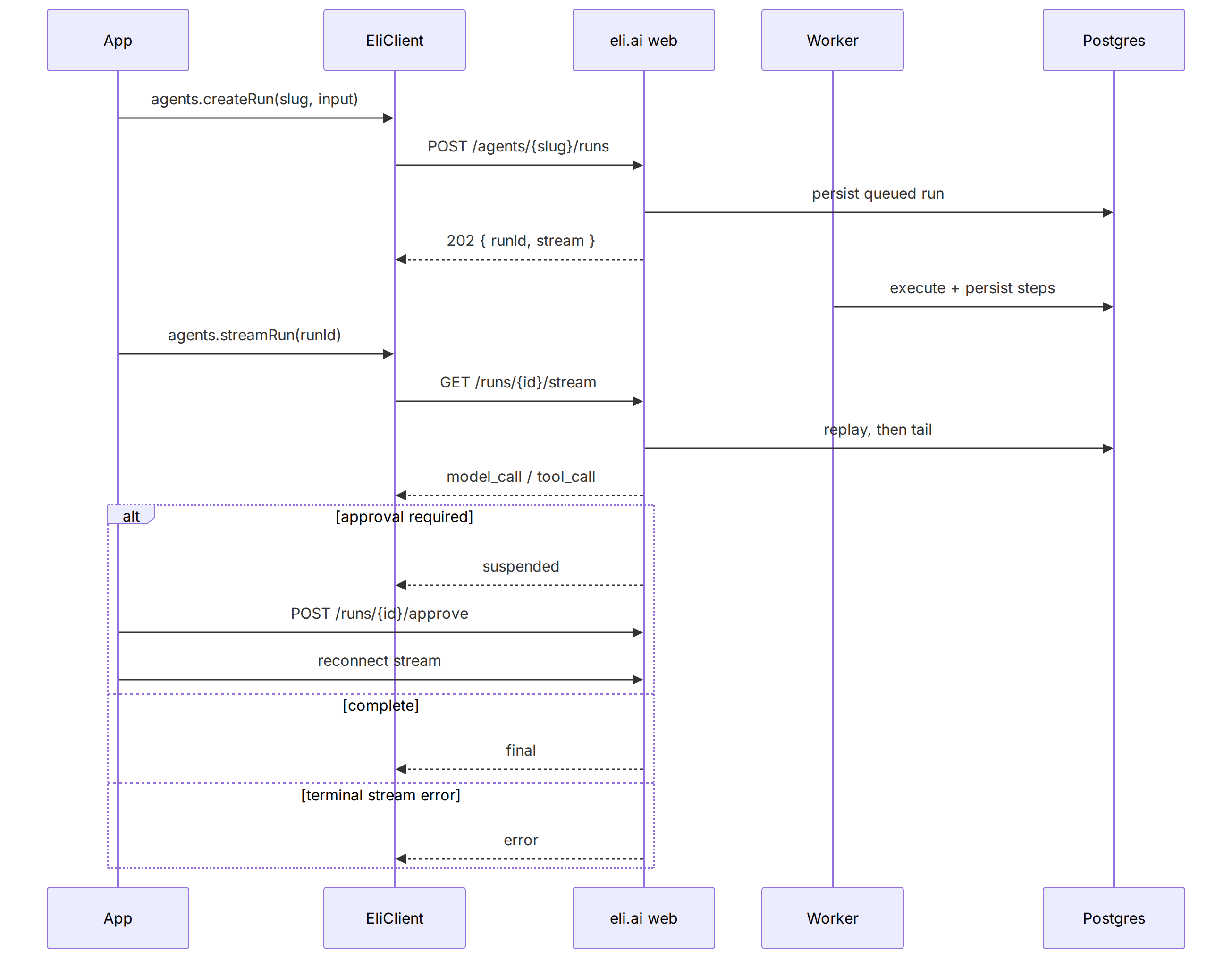
Starting an agent returns HTTP 202 with a durable run id and stream path. The worker executes independently; agents.streamRun() attaches to a database-backed replay/tail. Fetch is required instead of native EventSource because the stream needs Authorization and, for some user keys, X-Workspace-Id.
SDK durable run reattachment
A disconnected client does not stop or restart the durable run.
Downloads
Concepts
- Run flow
- SDK
Keywords
- eli.ai web
- model_call / tool_call
- agents.createRun(slug, input)
- persist queued run
- execute + persist steps
- GET /runs/{id}/stream
- replay, then tail
- POST /runs/{id}/approve
- reconnect stream
- POST /agents/{slug}/runs
- Postgres
- agents.streamRun(runId)
- App
- EliClient
- Worker
- suspended
- final
- error
Source and generation provenance
Status: current
Generated at: 2026-08-12T23:42:01.059Z
Source hash: afc808bcbfad3a043154ed09eac58c0aae0168fe7763ab57d48029b421417c08
Metadata payload hash: e042b0bae3bc6b6a66f9036e90616fe4e9fcc19bc07b641fedc81f97926750fd
Canonical appearance
src/app/(docs)/docs/api/sdk/page.tsx:50 route /docs/api/sdk
All appearances
canonical—src/app/(docs)/docs/api/sdk/page.tsx:50route/docs/api/sdk
No mirrored appearances.
Generation versions
App: eli-ai 0.1.0
Mermaid: 11.16.0 · Mermaid CLI: 11.16.0
Node: v26.3.1 · Yarn: 4.17.1
Renderer config hash: 68c10966fe84406ee626034d58bfabd555df9f65f691204b7c46db24038da101
Renderer theme hash: c80287a78d80ad63d27bd5ca348b2ef9a7e2f44da289e436be6484ea28a1b033
Adapter versions: diagramGenerator=2, drawioFlowchart=1, drawioGantt=1, drawioSequence=1, drawioState=1
Full sidecar JSON: sdk-durable-run-reattachment-afc808bc.json
Reconnects replay progress
agents.cancelRun(id) for cooperative cancellation. Streams close on suspended, final, error, or the current ten-minute safety timeout.React composition
React receives an already-constructed transport, or the transport retained from an aggregate client. That keeps key retrieval, tenant selection, same-origin proxying, and tracing outside the render tree. Each capability component constructs only its matching client module from that transport. Complete components use scoped eli-* classes and the optional CSS export; hooks remain usable with application-owned markup. EliProvider deliberately has no API-key prop.
No Next.js dependency
Current capability coverage
The headless client covers every operation in the current OpenAPI document. React adds complete components by product capability; MCP remains a separate protocol at /api/mcp.
| Capability | Canonical scopes | Current routes | React surface |
|---|---|---|---|
| Query & search | agents:run · kb:read | /query · /search | EliQuery · EliSearch |
| Documents | kb:read · kb:write | /documents · verify · lineage | EliDocuments · EliDocumentLineage |
| Entities & governance | kb:read · kb:write | /entities · /relations · /manifest · change requests · SKOS | EliKnowledgeGraph · EliGovernance |
| Live data | data:read · data:run | /data/connectors · /data/queries | EliLiveData |
| Reports | reports:read · reports:write | /reports | EliReports |
| Agents & runs | agents:run · runs:read | /agents/{slug}/runs · /runs/{id}/* | EliAgentRunner · EliRunDetail |
| Policy, evals & cache | kb:read · kb:write | /policy · /evals · /qrels · /cache/stats | EliQuality · EliPolicyDecisions · EliEvalMetrics · EliCacheStats |
| Content connectors | data:read · kb:write | /connectors · /connectors/{id}/sync | EliConnectors |
Canonical versus accepted read scopes
scope and acceptedScopes, matching OpenAPI's x-required-scope and x-accepted-scopes. OpenAPI recommends kb:read for graph, lineage, policy, eval, and cache reads; selected compatibility guards also accept older runs:read keys. New integrations should request the canonical scope.Error behavior
Non-2xx responses become EliApiError, retaining status, machine code, validation issues, parsed details, and the x-request-id when present. Fetch failures become EliTransportError; invalid successful JSON or response content types become EliProtocolError; malformed JSON in an SSE frame becomes EliSseParseError. Abort keeps its native identity. A terminal SSE error payload remains a yielded RunEvent.
- 400: fix request or workspace selection; do not retry unchanged input.
- 401: missing, invalid, or revoked credential.
- 402: monthly agent-spend admission blocked.
- 403: insufficient scope, live capability, or workspace grant.
- 404: unknown or cross-workspace resource; the distinction is intentionally hidden.
- 409: required model is not configured.
- 429: active-run capacity is full, not a general API throttle.
The current API has no universal pagination envelope, standard idempotency key, general rate limiter, or cross-origin CORS policy. Document enrichment is asynchronous after durable save, and run SSE is the only unified public push channel today.
Repository, registry, and HTTP use
Inside this repository, consume the version 0.1.0 workspace packages directly. Outside it, confirm the package-registry release before running the install commands. The HTTP/OpenAPI contract remains the interoperable fallback and source of truth: