Get started
Solution: the sales AI desk
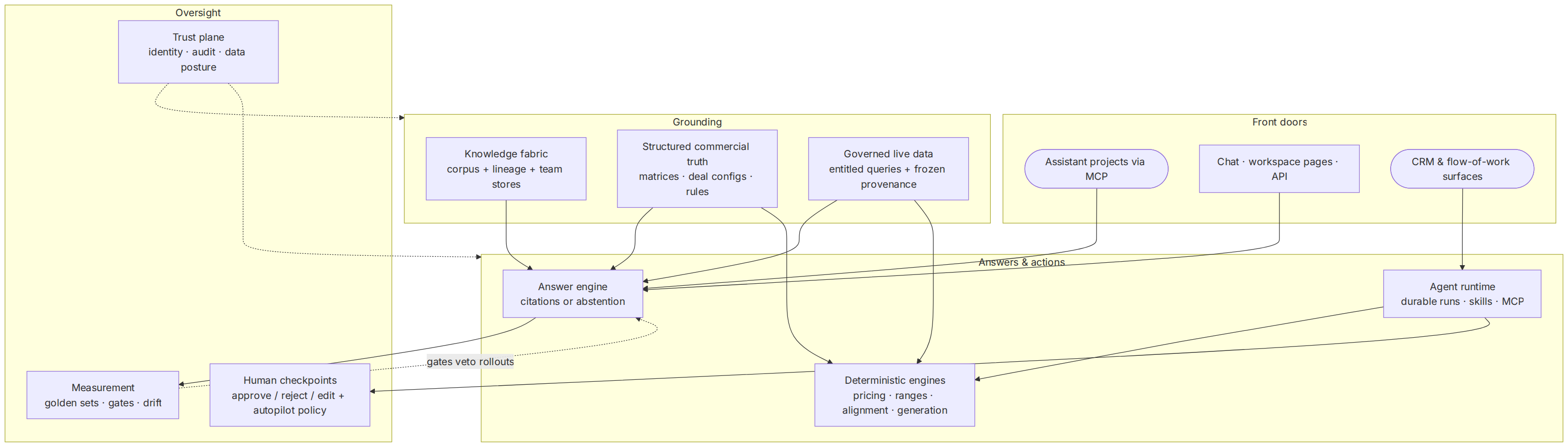
A sales organization whose product is delivered outcomes has a harder AI problem than most: every capability claim must trace to the packaging, every number a buyer sees must come from the same engine that will deliver and report it, and the actions that matter — issued proposals, contracts, reports — need a human who saw the draft andthe rationale. This page shows how the platform's systems compose into that solution end to end, and what each capability unlocks as the practice matures.
Sales AI capability map
Nine capability blocks, three planes — every arrow is governed by identity, audited, and measured.
Downloads

Concepts
- Sales AI
- Front doors
- Answers & actions
- Solutions
- Block
- Grounding
- Oversight
Keywords
- Assistant projects via MCP
- Chat · workspace pages · API
- durable runs · skills · MCP
- Knowledge fabric
- Governed live data
- Answer engine
- citations or abstention
- Deterministic engines
- Agent runtime
- Human checkpoints
- Trust plane
- gates veto rollouts
- CRM & flow-of-work surfaces
- corpus + lineage + team stores
- Structured commercial truth
- matrices · deal configs · rules
- entitled queries + frozen provenance
- pricing · ranges · alignment · generation
- approve / reject / edit + autopilot policy
- golden sets · gates · drift
- identity · audit · data posture
- Measurement
Source and generation provenance
Status: current
Generated at: 2026-08-12T23:41:39.420Z
Source hash: b7e85bb7ae7a38f7b9a84b39bb324a015640808f07e3cbf464c015e7504065d2
Metadata payload hash: 80853e3c3d5631c557d91d7963576adbe40bf6e5754219e561917ba5c871011a
Canonical appearance
src/app/(docs)/docs/solutions/sales-ai/page.tsx:28 route /docs/solutions/sales-ai
All appearances
canonical—src/app/(docs)/docs/solutions/sales-ai/page.tsx:28route/docs/solutions/sales-ai
No mirrored appearances.
Generation versions
App: eli-ai 0.1.0
Mermaid: 11.16.0 · Mermaid CLI: 11.16.0
Node: v26.3.1 · Yarn: 4.17.1
Renderer config hash: 68c10966fe84406ee626034d58bfabd555df9f65f691204b7c46db24038da101
Renderer theme hash: c80287a78d80ad63d27bd5ca348b2ef9a7e2f44da289e436be6484ea28a1b033
Adapter versions: diagramGenerator=2, drawioFlowchart=1, drawioGantt=1, drawioSequence=1, drawioState=1
Full sidecar JSON: sales-ai-capability-map-b7e85bb7.json
Grounding
Knowledge fabric
Proposals, RFP answers, and enablement content ground in a corpus with lineage: connectors and binary intake (.docx, .pptx, .pdf) normalize source material into revisioned, chunked, citable documents, and team-scoped file stores hold each team's decks and templates with explicit cross-team sharing — chat with a store the way you'd chat with a project. Unlocks: answers that survive an audit, and a rebrand library that compounds instead of scattering across drives.
Structured commercial truth
The product catalog's feature and program matrices become versioned structured records — schema-validated, projected into the corpus so retrieval can cite them — and each deal gets a first-class deal configuration record: package, options, volumes, terms. Decks, proposals, pricing, contract fill, and the product handoff all read the same record, so they cannot disagree. Unlocks:the one-engine property — September's proposal cites September's matrix version, and delivery receives exactly what was sold.
Governed live data
Warehouse and application reads go through named, read-only queries with per-user row entitlements (an unentitled ask fails loudly, never narrows silently) and value-frozen provenance: every result is snapshotted and hashed, so a figure cited in a report re-verifies months later even after the warehouse moved on. Unlocks:client-specific Q&A with real permissions, and amendment cycles that end with a hash check instead of an argument.
Answers and actions
The answer engine
Hybrid retrieval with reranking and graph fusion, ACL-filtered before ranking, produces answers whose every claim carries a citation with span-level offsets — and a workspace citation policy that validates coverage, retries with named gaps, and abstains rather than ships uncited. Flipping enforcement on is itself gated by the evaluation harness. Unlocks: sellers stop pulling engineering into live deals — escalation deflection you can count, not claim.
Deterministic engines
Numbers never come from the model. Pricing evaluates versioned pricing rules (unmatched rules return named skipped reasons, not silence); estimates return ranges with visible assumptions — no point-promise API exists; the alignment checker verifies every proposal claim against the matrices; and generation reads a versioned brand/template/example asset registry, so a rebrand is a version bump. Unlocks: pricing options at the moment rules exist, defensible pre-sale ranges, and decks that stay on-claim.
Agent runtime, skills, and the CRM
Durable agents run with pinned versions, budgets, and a governed tool allowlist — every step traced. MCP works in both directions: external tools (the CRM) mount as approval-gated agent tools, and the platform's own MCP server keeps assistant projects as a front door over governed, cited retrieval. Installable skills— versioned task instructions, installed workspace-wide or per team, optionally tied to a team's file stores — bring recurring formats (one-pagers, pre-call briefs, proposal skeletons) into chat with the team's own material attached, per the invoker's access. Unlocks: the same front doors from day one, with the backend swapping underneath — progressive grounding, not a rewrite.
Oversight
Human checkpoints, with earned autopilot
Consequential tool calls suspend the run durably into an approvals inbox — draft, rationale, and three verbs: approve, reject, or edit(the reviewer's payload executes; the original stays for audit), with SLA escalation. A per-tool review policy decides where a human is required and where autopilot is allowed — and autopilot is never fail-open: every autopiloted call is logged and risk-scored, risky calls escalate back to a human, a configurable sample lands in a retrospective review queue, and overturns tighten the policy automatically. Unlocks: pilot-period safety that relaxes into throughput as measured trust accrues, not as attention fades.
Measurement
The sales question catalog imports as the first golden test set; scheduled evals run the real pipeline; acceptance gates bind metric thresholds to consequential flips (citation enforcement, tool retirement, surface embedding); drift detection makes a regression a finding with a confidence interval. Unlocks:"measured lift" as a queryable fact — hours per asset, claims traced, amendments caught — and releases that cannot quietly regress.
The trust plane
Per-user, role-based access aligned to your identity system; row-level tenant isolation the database enforces; an append-only audit log; and a configurable model data-retention posture — providers assert a tier (standard / limited / zero), workspaces set a floor, and an under-posture provider refuses to serve client-specific work. Unlocks: client-data features that pass security review the first time.
The validation ladder, enforced
Related
- Sales enablement walkthrough — the five-system end-to-end guide
- Approvals & feedback — checkpoints, the edit verb, autopilot reviews
- Evaluation runs — golden sets, metrics, acceptance gates
- Workspace settings — citation policy, review policy, governance posture