End-to-end walkthroughs
Use case: sales enablement
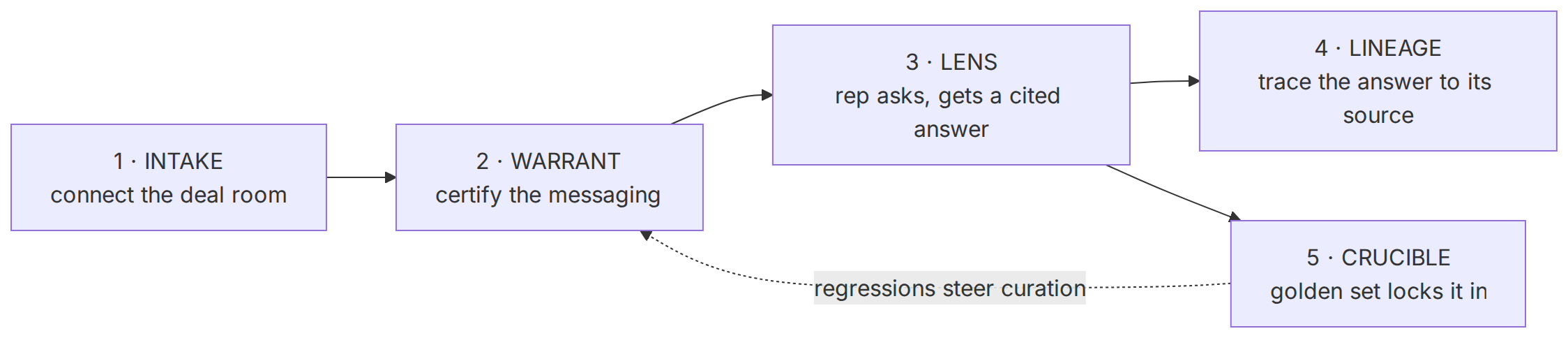
A sales team is only as good as its answers. A rep on a call needs the current pricing, the certified competitive positioning, and the security posture — not last quarter's deck, and not a confident hallucination. This guide builds that assistant end to end, touching five module slices: Intake to connect the deal room, Warrant to certify the messaging, Lens to answer with citations, Lineage to trace any answer back to its source, and Crucible to keep it accurate as the story changes.
Sales enablement knowledge workflow
One knowledge base, five slices. The dashed edge is the loop that keeps it honest: a regression the golden set catches steers the next round of curation.
Downloads

Concepts
- Use case sales enablement
- Guides
Keywords
- connect the deal room
- certify the messaging
- golden set locks it in
- rep asks, gets a cited answer
- trace the answer to its source
- regressions steer curation
- INTAKE
- WARRANT
- LENS
- LINEAGE
- CRUCIBLE
Source and generation provenance
Status: current
Generated at: 2026-08-12T23:41:41.605Z
Source hash: e8a345bdf3197e04980aaa460d474f53f03168b47380d57fe8f96f324aa3408c
Metadata payload hash: 48615d84fd3083fbc2d3790d90550001a7878c3e46097b835036e443983287a3
Canonical appearance
src/app/(docs)/docs/guides/use-case-sales-enablement/page.tsx:30 route /docs/guides/use-case-sales-enablement
All appearances
canonical—src/app/(docs)/docs/guides/use-case-sales-enablement/page.tsx:30route/docs/guides/use-case-sales-enablement
No mirrored appearances.
Generation versions
App: eli-ai 0.1.0
Mermaid: 11.16.0 · Mermaid CLI: 11.16.0
Node: v26.3.1 · Yarn: 4.17.1
Renderer config hash: 68c10966fe84406ee626034d58bfabd555df9f65f691204b7c46db24038da101
Renderer theme hash: c80287a78d80ad63d27bd5ca348b2ef9a7e2f44da289e436be6484ea28a1b033
Adapter versions: diagramGenerator=2, drawioFlowchart=1, drawioGantt=1, drawioSequence=1, drawioState=1
Full sidecar JSON: sales-enablement-knowledge-workflow-e8a345bd.json
Prerequisites
- A workspace key with
kb:write,kb:read,agents:run, andruns:read, exported as$ELI_KEY. See Getting started. - Owner/admin on the workspace, to create connectors and certify concepts.
- An enabled chat model, so
/querycan generate — otherwise409 no-model-configured.
1 · Intake — connect the deal room
Sales content already lives somewhere — a Confluence space of battlecards, a SharePoint of contracts, a Slack channel of deal debriefs. Wire it in as a content connector so it becomes searchable, citable documents that sync themselves. Create the source, then kick off the first full backfill:
/api/v1/connectorsBearer · kb:writeCreate a content connector source. The credential is stored encrypted and masked on every read; the source does nothing until its first sync is enqueued.
/api/v1/connectors/{id}/syncBearer · kb:writeEnqueue the first full sync. The worker persists every document in a page before advancing its checkpoint and upserts by (source_id, external_id), so retries replay safely rather than duplicate or skip content.
As documents land, the worker chunks them, embeds them, and runs entity extraction — Atlas builds the concept graph automatically. Watch the sync_runs history on the Connectors page. No source of your own? Post markdown directly with POST /api/v1/documents per Ingest documents — the rest of this guide is identical.
2 · Warrant — certify the messaging
Extraction gives you concepts at authority machine_extracted — a starting point, not a source of truth. Sales messaging has to be vouched for. In Warrant, curate the key concepts and certify the ones reps will quote — certified is the only tier an assistant states without hedging. Take the pricing concept, pin its definition, and sign off:
/api/v1/change-requestsBearer · kb:writePropose the canonical definition as a reviewable change rather than editing silently. Approval promotes authority to at least curated and records the reviewer on the revision.
/api/v1/entities/{id}/certifyBearer · kb:writeOwner/admin sign-off — authority certified. Also starts the review clock: nextReviewAt lands at now + the workspace's reviewIntervalDays, so certified messaging can't quietly go stale.
Do the same for the source document itself — verify the battlecard so its provenance carries a governance tier:
/api/v1/documents/{id}/verifyBearer · kb:writeGlean-style document verification. Stamps the verification tier, the verifier, and the next re-verify date — the governance block Lineage reports and the manifest counts.
Curate in the UI too
3 · Lens — the rep asks, and gets a cited answer
Now the payoff. A rep asks in plain language; Lens retrieves, grounds, and returns an answer with inline [Sn] citations, an atomic claims breakdown, and a policy decision that says how much to trust it. Certified concepts are stated plainly; thin evidence makes the policy hedge or abstain rather than bluff.
/api/v1/queryBearer · agents:runRun the grounded query pipeline: retrieval + entity detection + one generation + a groundedness check + the answer-policy engine. Returns a cited answer with a policy decision. The workspace comes from the key.
The policy block is the trust signal: answer at highconfidence because the evidence is a single certified source with no conflict. Ask something the corpus doesn't cover and the policy engine returns abstain or clarify instead of inventing a number — the behavior sales content demands. The same pipeline is a native MCP tool, so it drops straight into a rep's Claude or CRM assistant.
4 · Lineage — trace the answer back to its source
A sales manager reviewing the assistant asks the fair question: where is this coming from, and can I trust it? The answer cited S1 → docId 01KY10…. Pull that document's lineage and read the whole trail in one call — origin, governance, and the downstream answers it is grounding right now:
/api/v1/documents/{id}/lineageBearer · kb:read or runs:readThe unified per-document lineage trail: origin provenance, governance, the audit trail, derived knowledge, and downstream impact. This is how you prove an answer's pedigree end to end.
There it is, closed loop: the answer traces to a Confluence page (SALES-4471, source version 9), the document is certified, and it is currently grounding 14answers — so an edit to it has a known blast radius. The manager didn't have to trust the model; they read the pedigree. The full trail also lists the derived concepts and the dependent cache entries that would invalidate if the battlecard changed.
Same trail, in the document view
DocumentLineage as a visual trail on the document page (via the BFF at GET /api/w/{workspaceId}/documents/{docId}/lineage), and an agent can pull it mid-run with the kb_document_lineage MCP tool. One shape, three surfaces.5 · Crucible — lock the accuracy in
Sales messaging changes constantly, and a wrong answer to a prospect is expensive. Capture the questions reps actually ask as a golden set so Crucible can prove the assistant still answers them correctly after every content change. Anchor a golden item to the certified pricing concept, and seed a provenance qrel from the battlecard chunk that should ground it:
/api/v1/qrelsBearer · kb:writeAuthor a graded relevance judgment for a golden item. source=provenance derives the highest-grade judgment from the item's anchored citation — deterministic, no judge model needed.
Run the set from the evals workspace, then read the metrics for the run. Retrieval and abstention numbers are deterministic; RAGAS numbers come from a judge model, pinned on the eval config so a comparison is never judged by two different rulers:
/api/v1/evals/runs/{id}/metricsBearer · kb:read or runs:readRetrieval, RAGAS, and abstention metrics for one run. The ruler for 'did the assistant get worse?'
When a metric drops after a messaging update, the golden set names exactly which question regressed — and promoting that miss back into the set turns it into a permanent test. That is the dashed loop in the diagram: Crucible's regressions steer the next round of Warrant curation. Compare two configs with a two-gate significance test in Measure & compare.
The leverage
Five slices, one knowledge base, one audit trail. The rep gets a fast, cited answer; the manager can trace any answer to a certified source and see its blast radius; and the whole thing is measured, so accuracy is a number you watch rather than a hope. Swap "sales" for support, onboarding, or compliance and the shape is identical — the platform doesn't care what the documents are about, only that every answer is grounded, governed, traceable, and measured.
Keep going