Lens
Retrieval pipeline
Hybrid retrieval fuses full-text and vector search into one ranked list. That primitive is excellent at recall and needs no score calibration — but it never reads the query against the text, it cannot follow the graph, and it packs context by chunk count rather than by what fits. The retrieval pipeline is a thin orchestrator that layers four research-backed stages over that primitive: query understanding, graph fusion, reranking, and a token-budget assembler. Each stage is a no-op when disabled or unavailable, so a workspace with no reranker key and understanding off gets exactly today's behavior — the upgrades are opt-in and degrade cleanly.
The primitive is untouched
retrieve(workspace, query, opts) — the raw FTS + vector RRF channel — is unchanged. The pipeline composes over it and over the existing graph-traversal service; it never replaces them. When every new stage is inactive, retrievePipeline returns the raw retrieve result byte-for-byte, which is what keeps eval baselines and the search/MCP raw callers reproducible.The five stages
Hybrid retrieval pipeline
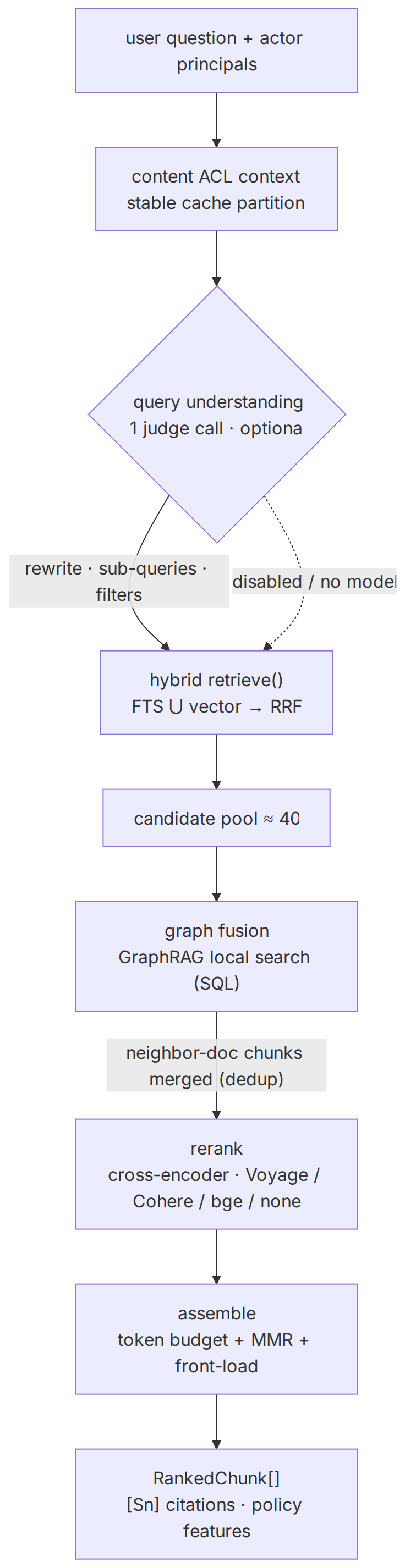
authorize → understand → hybrid → graph-fuse → rerank → assemble. The dotted edge is the degrade path: with no judge model, understanding is skipped and the raw question flows straight into hybrid retrieval. Authorization is not optional: every branch retains the same content ACL.
Downloads

Concepts
- Retrieval pipeline
- Pipeline
Keywords
- GraphRAG local search (SQL)
- content ACL context
- stable cache partition
- query understanding
- hybrid retrieve()
- FTS ⋃ vector → RRF
- disabled / no model
- candidate pool ≈ 40
- graph fusion
- user question + actor principals
- rewrite · sub-queries · filters
- neighbor-doc chunks merged (dedup)
- token budget + MMR + front-load
- rerank
- assemble
- Sn
- cross-encoder · Voyage / Cohere / bge / none
Source and generation provenance
Status: current
Generated at: 2026-08-12T23:39:16.709Z
Source hash: 00e116d0a0063ec9197ca8f3cee087793bae0869651944206480373757ba5af8
Metadata payload hash: 3f2a63437992214e6ff73d50fcc885625bad04e183ba7f089e8b4cd896699138
Canonical appearance
src/app/(docs)/docs/concepts/retrieval-pipeline/page.tsx:26 route /docs/concepts/retrieval-pipeline
All appearances
canonical—src/app/(docs)/docs/concepts/retrieval-pipeline/page.tsx:26route/docs/concepts/retrieval-pipeline
No mirrored appearances.
Generation versions
App: eli-ai 0.1.0
Mermaid: 11.16.0 · Mermaid CLI: 11.16.0
Node: v26.3.1 · Yarn: 4.17.1
Renderer config hash: 68c10966fe84406ee626034d58bfabd555df9f65f691204b7c46db24038da101
Renderer theme hash: c80287a78d80ad63d27bd5ca348b2ef9a7e2f44da289e436be6484ea28a1b033
Adapter versions: diagramGenerator=2, drawioFlowchart=1, drawioGantt=1, drawioSequence=1, drawioState=1
Full sidecar JSON: hybrid-retrieval-pipeline-00e116d0.json
ACL invariants survive every optional stage
1 · Query understanding
One structured judge call turns the raw question into a better retrieval query: a rewrite (the query actually run), up to three sub-queries for a bounded multi-query union that widens recall on multi-facet questions, advisory metadata filters (pathPrefix, entityTypes, docTitleContains), and an isAmbiguous flag. This deliberately replaces HyDE: research found that a direct rewrite plus decomposition beats embedding a speculative hypothetical document, at a fraction of the cost. Filters are advisory — a soft scope, never a hard exclusion that could zero out retrieval. The judge slot is the same model the answer policy already resolved; with no model, or the stage disabled, understanding returns nothing and the raw question is used.
2 · Hybrid retrieval + RRF (the primitive)
The effective query (rewrite, or the raw question) runs through retrieve — the two-channel hybrid described in Retrieval & grounded chat: websearch_to_tsquery full-text and pgvector cosine, combined with reciprocal-rank fusion (RRF, k = 60). The pipeline runs it wide — a candidate pool of ~40 chunks rather than the final answer budget — so the later reranking and assembly stages have real headroom to reorder and prune. Sub-queries retrieve into the same pool and merge by chunkId, keeping the max score.
3 · Graph fusion (GraphRAG local search)
RRF ranks text; it cannot follow a relationship. Graph fusion closes that gap with pure-SQL local search, reusing the same traversal service the graph channel uses:
- collect the entities mentioned in the seed chunks' documents (canonical rollup, served-lifecycle only — draft, pending-review, and deleted entities are excluded), ranked by mention count, top 8;
expandFrontierover those seeds for a relevance-pruned 1–2 hop neighborhood (inverse-degree damping already stops hub nodes from dominating);- resolve the neighbor entities to their documents, then run a scoped
retrieveover just those docs.
The result is chunks the raw lexical/vector pass missed because the connection was structural, not textual — an owner named in an adjacent runbook, a system two hops from the one you asked about. Those chunks merge into the pool tagged graphBoosted. It is deterministic and involves no LLM. Graph fusion respects a document scope when one is set: expansion still applies, bounded to the allowed documents.
4 · Reranking (cross-encoder)
RRF fuses rank positions; it never scores a chunk's text against the query. A cross-encoder reranker does exactly that — it reads (query, chunk) pairs jointly and emits a calibrated relevance score in [0, 1], which the pipeline uses to re-sort the pool. This is the single largest precision lever in modern RAG, and it is a pluggable adapter: Voyage rerank-2.5 (the default when a key is present), Cohere rerank-v3.5, a self-hosted bge-reranker-v2-m3 (ONNX), or none (identity passthrough). Provider details, auto-resolution, and cost are in Reranking. Any adapter error falls back to the fused RRF order — a reranker outage never fails the answer.
License guard
bge-reranker-v2-m3 (Apache 2.0); the commercial API providers (Voyage, Cohere) are used under their commercial terms.5 · Token-budget assembly
The old context step packed a fixed number of chunks. The assembler packs to a token budget (default 6,000, estimated at ~4 chars/token) with a hard cap of 20 chunks, which is what actually matters for a context window — a handful of long chunks and a dozen short ones cost very differently. Two more things happen here, both deterministic:
- MMR de-duplication.Greedy Maximal Marginal Relevance (λ = 0.7) trades relevance against redundancy using Jaccard similarity over normalized token shingles — no embeddings needed at assembly time, so it reproduces byte-for-byte. Near-duplicate chunks (Jaccard ≥ 0.9 to an already-selected chunk) are dropped outright, so three copies of the same paragraph don't eat the budget three times.
- Front-loading.The highest-scored chunk is always seated first, and stronger evidence leads — a direct mitigation for "lost in the middle," the finding that models attend best to the start and end of a long context and degrade in the middle.
The reranker score, when present, is the relevance signal MMR reads; otherwise it falls back to the fused score. The output is a RankedChunk[]capped at the caller's answer budget.
Degradation is the design
Every stage has an inactive path, and inactivity is defined by availability, not just a toggle: understanding without a judge model, a reranker that resolves to none (no key, self-host dep absent), and graph fusion disabled all count as inactive. When all three are inactive, the pipeline short-circuits to a plain retrieve(question, {limit, docIds})and skips the assembler entirely — the token-budget/MMR machinery only engages once an active stage has widened the pool. That is what makes "all stages off" identical to today'sretrieve + slice, and why eval reproducibility survives adding the pipeline.
The two non-deterministic stages — understanding and remote reranking — each have a deterministic-off path (no model; the none reranker), so an eval run can pin the pipeline to a fully reproducible configuration. Graph fusion and the assembler are deterministic always.
Those counts, plus the query rewrite and the reranker kind, ride along on a structured answer as an optional retrievalDebug block — see Structured query.
Research grounding
Like the answer policy, none of this is invented here — each stage maps to a published result:
| Mechanism | Where it lives | Research grounding |
|---|---|---|
| Cross-encoder rerank | rerank stage · Voyage default | Voyage rerank-2.5 leads public reranking benchmarks — ≈ +7.9% over Cohere rerank-v3.5 on Voyage's cross-domain evaluation; a second-stage encoder reads the query against each chunk, which RRF structurally cannot. |
| Self-host reranker | onnx-bge adapter | bge-reranker-v2-m3 (Apache 2.0) — strong BEIR reranking with no API dependency and a commercial-safe license; mxbai/bge are the permissive open baselines. |
| Query understanding over HyDE | understand.ts | Rewrite + sub-query decomposition + metadata filters outperform HyDE for production RAG; one judge call replaces a speculative-document embed. |
| GraphRAG local search | graph-fusion.ts | Microsoft GraphRAG: entity-anchored local search surfaces structurally-related evidence that lexical and vector recall miss. |
| Token-budget + front-load | assemble.ts | Pack by token budget, not chunk count, and front-load the strongest evidence to fight 'lost in the middle' (Liu et al. 2023 — models under-use the middle of long contexts). |
| MMR de-duplication | assemble.ts | Maximal Marginal Relevance (Carbonell & Goldstein 1998): trade relevance against redundancy so near-duplicate chunks don't crowd out coverage. |
| License guard | RerankerKind union | Jina reranker v3 and zerank-2 excluded (CC-BY-NC): non-commercial weights cannot ship in a distributed product. |
Put it to work
/search stays on the primitive unless you pass ?rerank=true. Choose providers and read the cost note in Reranking, and walk the full tuning loop in Tune retrieval quality.