Ports
Write-via-approval
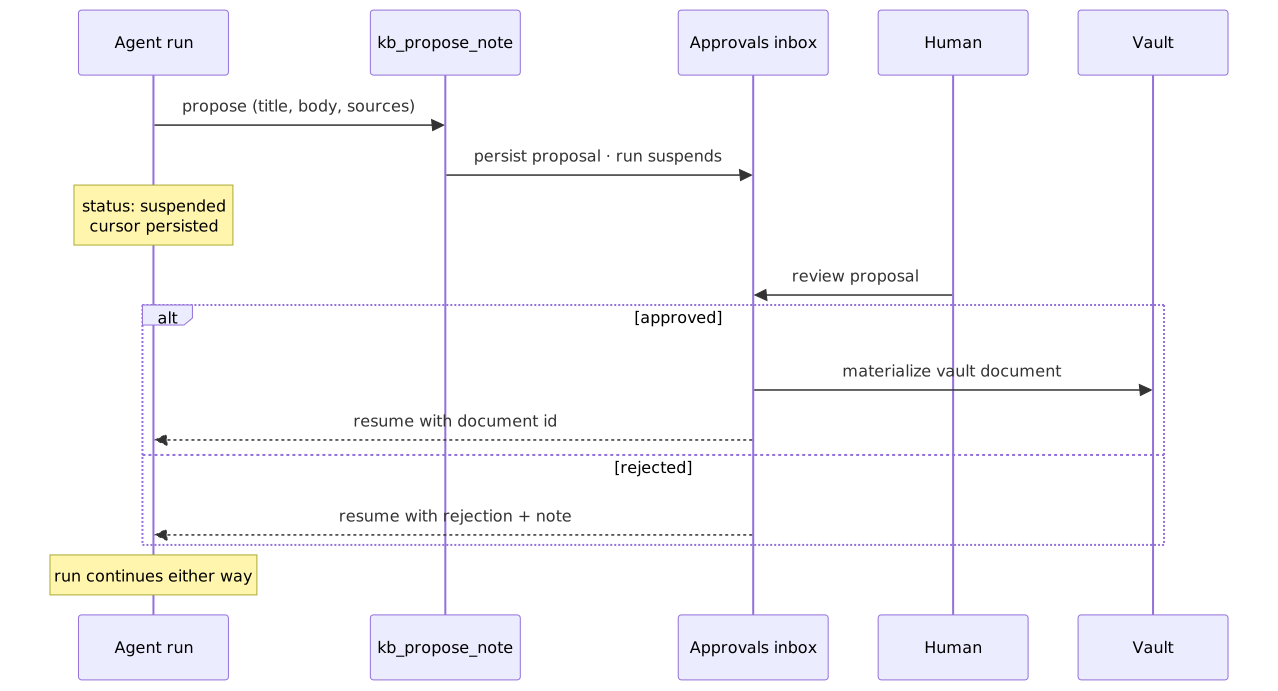
Agents read the knowledge base freely — but they never write to it directly. The only agent write path into the KB is kb_propose_note: the agent proposes a note, the run suspends into the approvals inbox, and a human decision either materializes a vault document or resumes the run with a rejection. The KB stays a human-curated asset.
The flow
Write-via-approval lifecycle
propose → suspend → human decision → materialize or resume with rejection.
Downloads
Concepts
- Write via approval
- Capabilities
- Propose
Keywords
- Agent run
- Approvals inbox
- status: suspended
- cursor persisted
- review proposal
- resume with document id
- propose (title, body, sources)
- persist proposal · run suspends
- materialize vault document
- resume with rejection + note
- run continues either way
- kb_propose_note
- Human
- Vault
Source and generation provenance
Status: current
Generated at: 2026-08-12T23:43:38.769Z
Source hash: 0025a784a2aad21c8ca0f826d00fa88f81b18b375b30dc8d7608feb55765adbc
Metadata payload hash: 069e3f2c663fda06bdb42eed11167b667425ca18ca5f16858bd29199334e2e83
Canonical appearance
src/app/(docs)/docs/capabilities/write-via-approval/page.tsx:31 route /docs/capabilities/write-via-approval
All appearances
canonical—src/app/(docs)/docs/capabilities/write-via-approval/page.tsx:31route/docs/capabilities/write-via-approval
No mirrored appearances.
Generation versions
App: eli-ai 0.1.0
Mermaid: 11.16.0 · Mermaid CLI: 11.16.0
Node: v26.3.1 · Yarn: 4.17.1
Renderer config hash: 68c10966fe84406ee626034d58bfabd555df9f65f691204b7c46db24038da101
Renderer theme hash: c80287a78d80ad63d27bd5ca348b2ef9a7e2f44da289e436be6484ea28a1b033
Adapter versions: diagramGenerator=2, drawioFlowchart=1, drawioGantt=1, drawioSequence=1, drawioState=1
Full sidecar JSON: write-via-approval-lifecycle-0025a784.json
The kb_propose_note tool
kb_propose_noteis a built-in tool available to agents. A call carries the proposed note — title, markdown body, and the sources it was derived from — and behaves like any other gated tool call: the run's status becomes suspended, the full resume cursor is persisted, and the proposal lands in the workspace's approvals inbox alongside gated MCP calls.
Approve or reject
- Approve — the proposal is materialized as a real vault document: markdown on disk, indexed, extractable, citable — indistinguishable from a document a human wrote, except its provenance records the proposing run. The run resumes with the new document's id and can reference it in its final answer.
- Reject — nothing is written. The run resumes with a rejection result (and your optional note), which the model sees as the tool outcome and can react to — revise the proposal, continue without it, or report why the note was declined.
Because the suspend/resume record is durable, the human can take hours or days; the run picks up from its persisted cursor either way — even across a process restart.
Why agents never write directly
This is a deliberate architectural line, not a missing feature:
- The KB is the asset.Retrieval, extraction, coverage scoring, and every downstream answer are grounded in vault documents. One hallucinated "fact" written directly would be laundered into a citable source and poison everything built on it.
- Prompt-injection containment. Agents read untrusted content — imported documents, MCP tool output, the web. A write gate means injected instructions can at worst propose a note a human will read, never silently plant one.
- Provenance and audit.Every agent-originated document traces to a proposal, a run, and a named approver — the story an enterprise client expects when they ask "who put this here?".
- Quality stays measurable. Approval decisions are captured as feedback signal, so the proposal-acceptance rate becomes a measurable quality metric per agent version.
One gate, no exceptions
Related
- Approvals & feedback — the inbox where proposals land, and the feedback loop approvals feed.
- Tools, MCP & HITL — the suspend/resume machinery underneath.
- Knowledge base & vault — what a materialized document becomes part of.