Overview
System diagrams
eli.ai is eight systems that compose. This page shows how they fit together — first the shape of the machine as one plate, then the master flow of a document and a question through the whole platform, then a detailed internal architecture diagram for each system, with every node mapped to a real module or table. For the narrative overview, see the capability map; to see the systems in action, seed a demo workspace.
The shape of the machine
Every step of the grounded answer path, listed in order below, followed by all eight systems and every documented handoff between them. On large screens the plate also draws those systems and handoffs as a map, with this path picked out.
- Intake
Normalize source material and preserve source permissions.
- Atlas
Connect evidence through typed entities and relations.
- Warrant
Apply certification, lifecycle, and content ACL policy.
- Lens
Retrieve, rerank, answer, clarify, or abstain.
- Ports
Deliver the result to a person or programmatic caller.
- Intake
- Atlas
- Warrant
- Lineage
- Conduit
- Lens
- Crucible
- Ports
All system handoffs
- Intake → Atlas Normalized documents feed typed entity and relation extraction with sentence evidence.
- Atlas → Warrant Graph concepts receive authority tiers, lifecycle state, ownership, and governed change.
- Atlas → Lens Graph neighborhoods join lexical and vector retrieval before reranking.
- Warrant → Lens Content ACLs and certification state constrain what the answer pipeline may state.
- Conduit → Lens Entitled named queries contribute live rows and auditable Data Citations.
- Lens → Ports Grounded results reach the workspace, REST clients, MCP hosts, and durable agents.
- Lens → Crucible The real answer pipeline runs against golden sets and measured quality gates.
- Crucible → Warrant Significance-gated evaluation results govern consequential configuration changes.
- Lens → Lineage Answer claims, source revisions, data calls, and policy verdicts remain traceable.
- Lineage → Intake Reverse provenance resolves a result back to the exact ingested source revision.
The plate is the same eight systems and the same handoffs as the charts below, said without any table names: every documented edge is drawn, the grounded-answer path is picked out, and the “All system handoffs” list gives the mechanism behind each edge in words. Read it first if the flowcharts below are more machinery than you need — they are the implementation view of this picture, not a different one.
How the eight systems interconnect
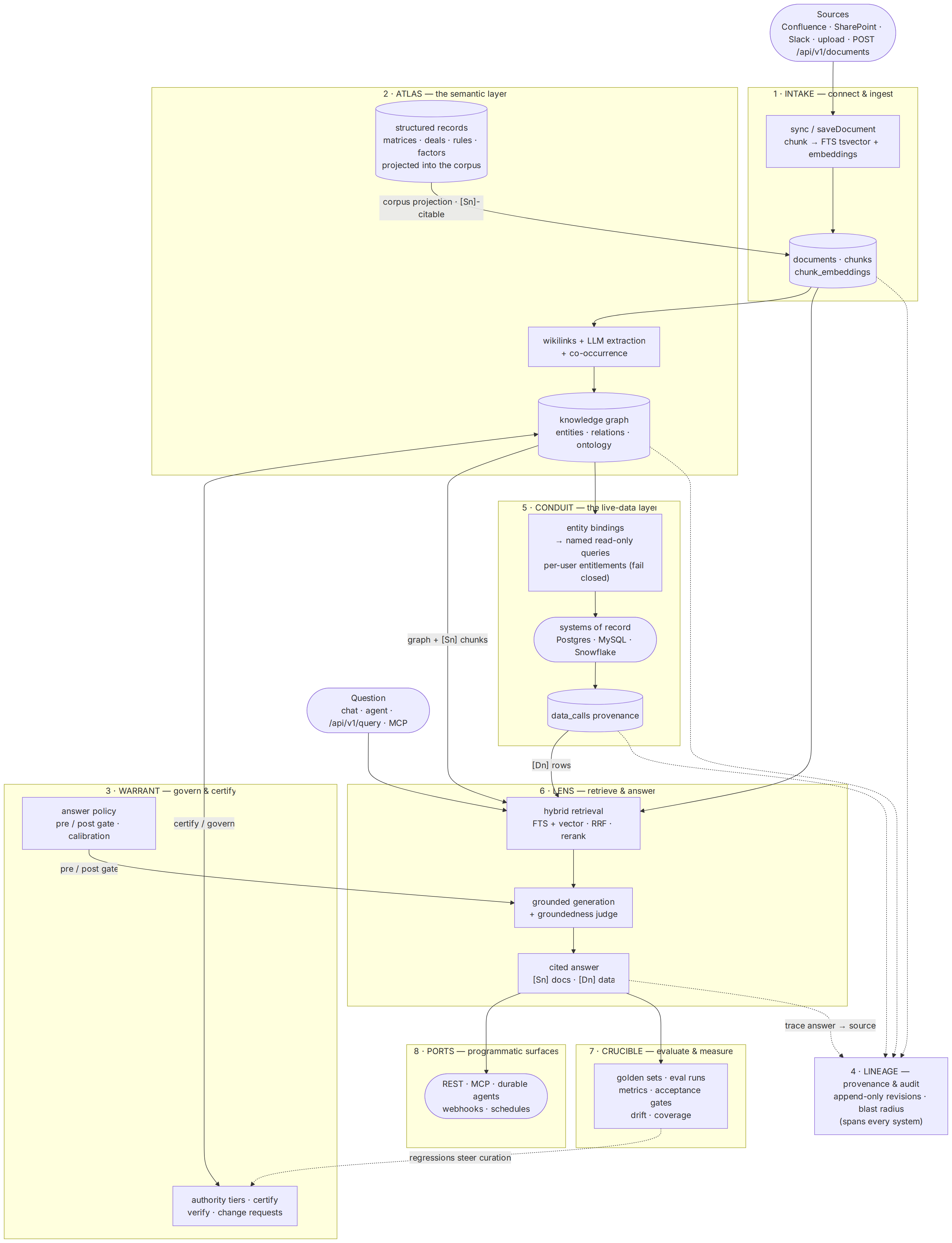
A document enters through Intake, becomes the Atlas graph, and is governed by Warrant. A question is answered by Lens, which retrieves over that graph and the chunks, joins live systems of record through Conduit, and gates the answer on the policy engine — then hands it to a consumer through Ports. Crucible measures the answers and steers the next round of curation, and Lineage makes the whole thing traceable end to end. The dashed edges are the feedback loops that keep it honest.
End-to-end interconnect
The document pipeline (Intake → Atlas → Warrant), the question pipeline (Lens over the graph + Conduit live data, gated by the answer policy, out through Ports), and the two feedback loops — Crucible regressions steering Warrant curation, and every answer traceable back to its source through Lineage.
Downloads

Concepts
- System diagrams
- End-to-end interconnect
- INTAKE — connect & ingest
- ATLAS — the semantic layer
- WARRANT — govern & certify
- CONDUIT — the live-data layer
- LENS — retrieve & answer
- CRUCIBLE — evaluate & measure
- PORTS — programmatic surfaces
- Master
Keywords
- chat · agent · · MCP
- Postgres · MySQL · Snowflake
- REST · MCP · durable agents
- data_calls provenance
- sync / saveDocument
- documents · chunks
- knowledge graph
- structured records
- answer policy
- entity bindings
- systems of record
- hybrid retrieval
- grounded generation
- groundedness judge
- golden sets · eval runs
- drift · coverage
- webhooks · schedules
- spans every system
- certify / govern
- graph + [Sn] chunks
- [Dn] rows
- pre / post gate
- trace answer → source
- chunk → FTS tsvector + embeddings
- wikilinks + LLM extraction
- entities · relations · ontology
- matrices · deals · rules · factors
- projected into the corpus
- authority tiers · certify
- verify · change requests
- pre / post gate · calibration
- → named read-only queries
- per-user entitlements (fail closed)
- FTS + vector · RRF · rerank
- metrics · acceptance gates
- LINEAGE — provenance & audit
- append-only revisions · blast radius
- corpus projection · [Sn]-citable
- regressions steer curation
- chunk_embeddings
Source and generation provenance
Status: current
Generated at: 2026-08-12T23:38:15.207Z
Source hash: 6c649318916666d8620ba4482045b32e1a5092503cedd184cc2ed7e335055147
Metadata payload hash: 73fe22adc41c5e5272597e54419e2d329b49eaf8459a0cbef064ba62fc2df52f
Canonical appearance
src/app/(docs)/docs/concepts/system-diagrams/page.tsx:59 route /docs/concepts/system-diagrams
All appearances
mirror—docs/architecture/system-diagrams.md:28canonical—src/app/(docs)/docs/concepts/system-diagrams/page.tsx:59route/docs/concepts/system-diagrams
Generation versions
App: eli-ai 0.1.0
Mermaid: 11.16.0 · Mermaid CLI: 11.16.0
Node: v26.3.1 · Yarn: 4.17.1
Renderer config hash: 68c10966fe84406ee626034d58bfabd555df9f65f691204b7c46db24038da101
Renderer theme hash: c80287a78d80ad63d27bd5ca348b2ef9a7e2f44da289e436be6484ea28a1b033
Adapter versions: diagramGenerator=2, drawioFlowchart=1, drawioGantt=1, drawioSequence=1, drawioState=1
Full sidecar JSON: end-to-end-interconnect-6c649318.json
Each system, inside
Eight diagrams, one per system — inputs on the way in, the internal stages and stores, and what each hands to the next. Every node names a real module or table.
1IntakeConnect & ingest
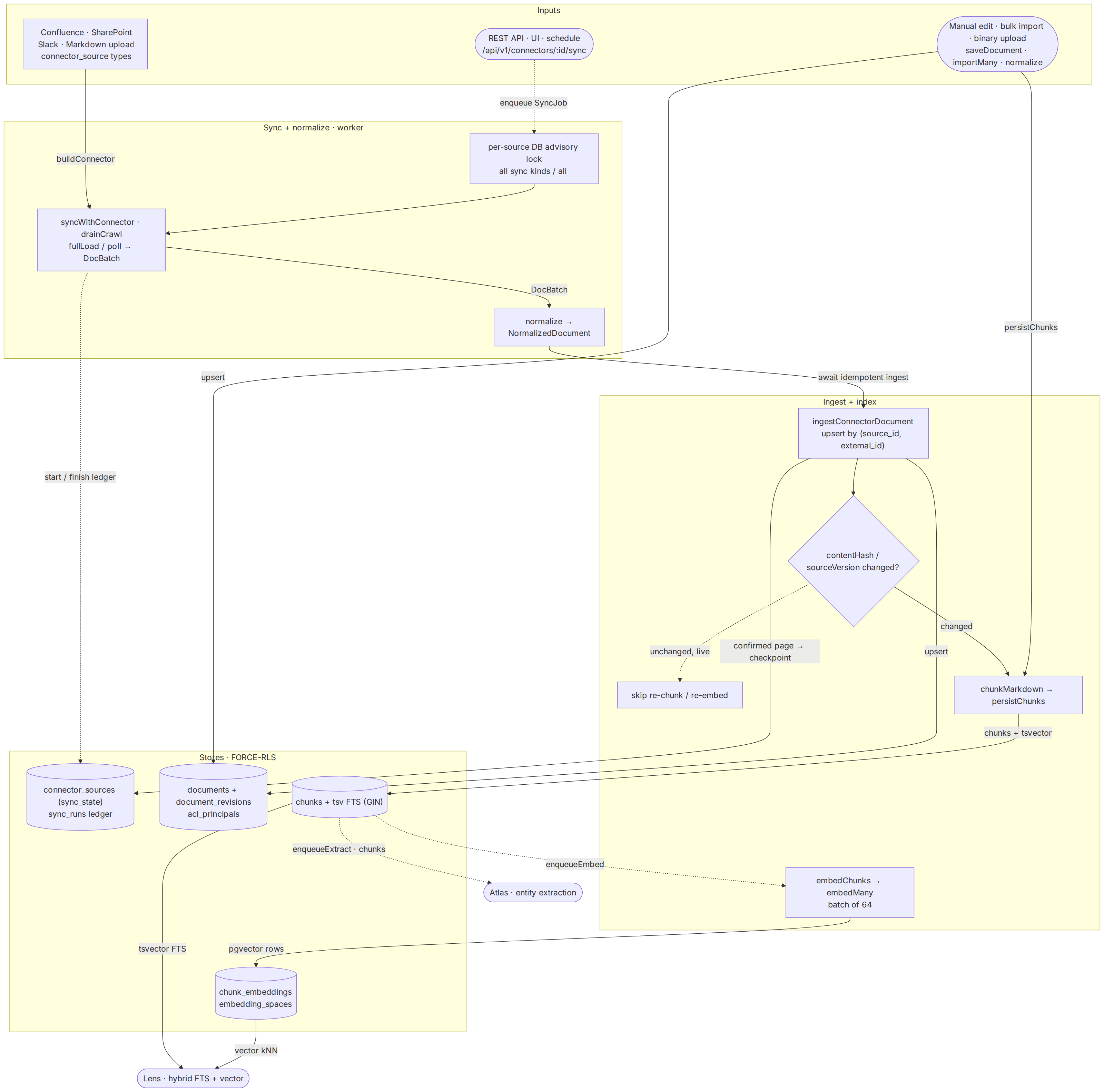
Confluence, SharePoint, Slack, and markdown-upload sources share one contract. Remote connector requests use the shared address-pinned, redirect-revalidating, bounded HTTP client. A database advisory lock serializes every sync kind for a workspace/source across queues and workers. The crawl awaits each idempotent ingestConnectorDocument upsert before persisting the page checkpoint, so acknowledged progress cannot outrun document/revision state. Unchanged content skips re-chunk/re-embed; a real change appends document_revisions, writes ACL principals, reconciles chunks/FTS, and dispatches embedding/extraction. Manual text import uses saveDocument/importMany and converges on the same derived stores through its caller-owned enrichment path.
Intake — connect and ingest
Intake serializes each source, ingests every normalized document before advancing its checkpoint, writes revision/ACL metadata, and dispatches searchable chunk enrichment.
Downloads

Concepts
- System diagrams
- Ingest + index
- Intake — connect and ingest
- Sync + normalize · worker
- Inputs
- Intake
Keywords
- REST API · UI · schedule
- connector_source types
- upsert by (source_id, external_id)
- documents + document_revisions
- Confluence · SharePoint
- Slack · Markdown upload
- normalize →
- contentHash /
- sourceVersion changed?
- embedChunks → embedMany
- batch of 64
- enqueue SyncJob
- start / finish ledger
- await idempotent ingest
- unchanged, live
- chunks + tsvector
- pgvector rows
- enqueueExtract · chunks
- tsvector FTS
- vector kNN
- Manual edit · bulk import · binary upload
- saveDocument · importMany · normalize
- per-source DB advisory lock
- all sync kinds / all workers
- syncWithConnector · drainCrawl
- fullLoad / poll → DocBatch
- skip re-chunk / re-embed
- chunkMarkdown → persistChunks
- Atlas · entity extraction
- Lens · hybrid FTS + vector
- confirmed page → checkpoint
- sync_state
- acl_principals
- chunk_embeddings
- embedding_spaces
- /api/v1/connectors
- id/sync
- NormalizedDocument
- ingestConnectorDocument
- GIN
Source and generation provenance
Status: current
Generated at: 2026-08-12T23:39:30.559Z
Source hash: 98d98cb8b75042b0195fab5ad998bd0804f6e9ad5add341e71b3eaa7ca95b21e
Metadata payload hash: c9615427ae6b8b04b9d327b83168a6faaedb5c5d38111ffbb8ed8062d73070e7
Canonical appearance
src/app/(docs)/docs/concepts/system-diagrams/page.tsx:111 route /docs/concepts/system-diagrams
All appearances
mirror—docs/architecture/system-diagrams.md:97canonical—src/app/(docs)/docs/concepts/system-diagrams/page.tsx:111route/docs/concepts/system-diagrams
Generation versions
App: eli-ai 0.1.0
Mermaid: 11.16.0 · Mermaid CLI: 11.16.0
Node: v26.3.1 · Yarn: 4.17.1
Renderer config hash: 68c10966fe84406ee626034d58bfabd555df9f65f691204b7c46db24038da101
Renderer theme hash: c80287a78d80ad63d27bd5ca348b2ef9a7e2f44da289e436be6484ea28a1b033
Adapter versions: diagramGenerator=2, drawioFlowchart=1, drawioGantt=1, drawioSequence=1, drawioState=1
Full sidecar JSON: intake-connect-and-ingest-98d98cb8.json
Key modules & tables
- src/server/connectors/sync.ts — advisory lock, inline drainCrawl ingestion before checkpoint, revisions, prune and permission refresh
- src/server/connectors/sources/http.ts + src/server/network — validated, address-pinned connector HTTP with redirect, time and size bounds
- src/server/connectors/registry.ts + types.ts — Connector fullLoad / poll / listIds / getPermissions contract
- src/server/vault/index.ts + src/server/ingest/bulk.ts — recoverable manual save and text bulk-import path
- src/server/ingest/chunking.ts — chunkMarkdown + persistChunks; generated tsvector/GIN index
- src/server/ai/embeddings.ts — embedChunks → embedMany into the active embedding space
- Tables: connector_sources, sync_runs, documents, document_revisions, chunks, chunk_embeddings, embedding_spaces
2AtlasThe semantic layer
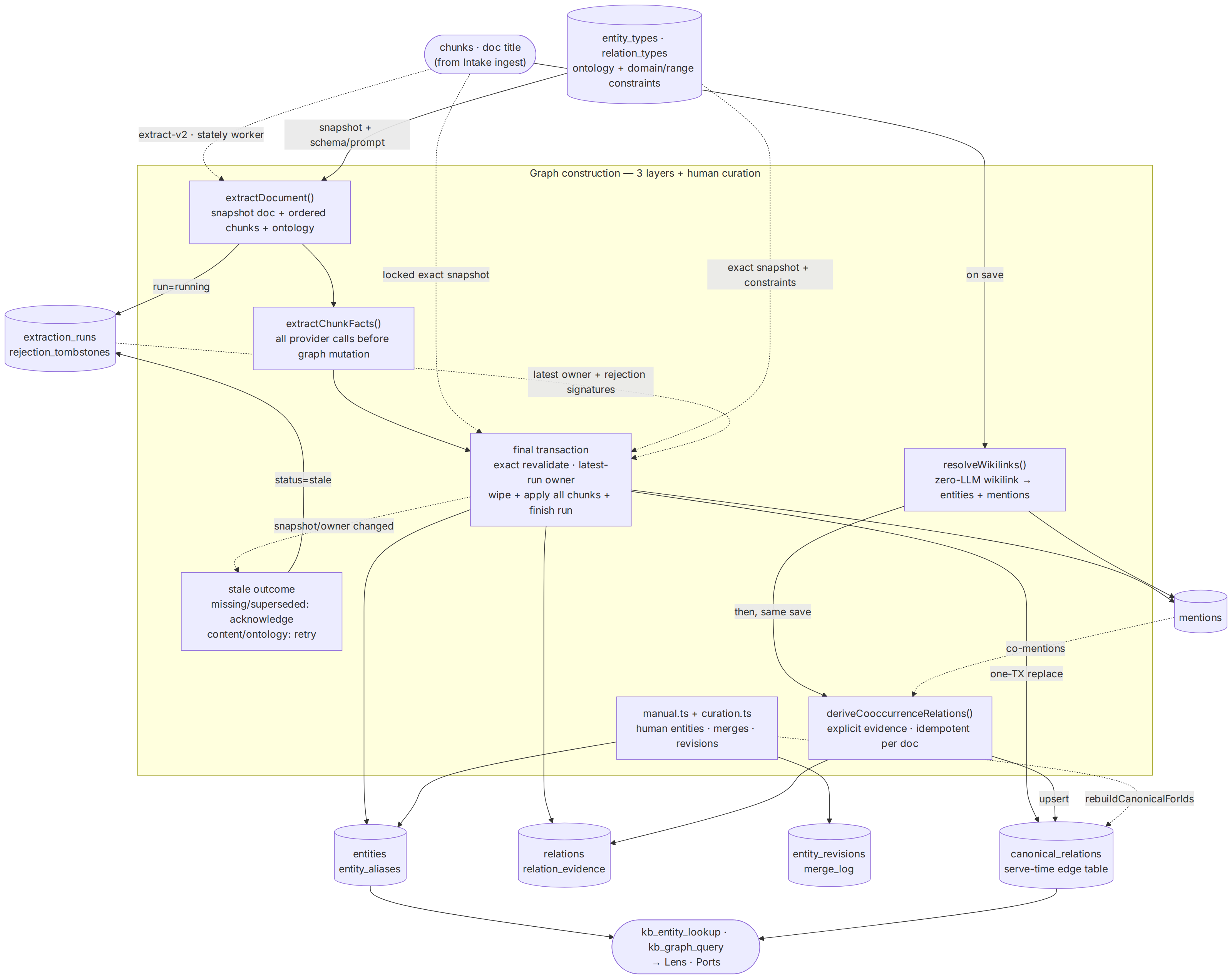
Chunks enter Atlas through zero-model [[wikilink]] resolution and capped co-occurrence edges. Co-occurrence carries explicit synthetic provenance and replaces its own document pair set idempotently. New model work uses the stately extract-v2 queue: the worker snapshots the exact document, ordered chunks, and ontology, completes every provider call before graph mutation, then locks and revalidates those inputs plus latest-run ownership. One transaction wipes the previous model projection, applies every chunk, rebuilds canonical edges, and completes the run, so the last-good graph remains visible on failure or stale work. Missing/superseded runs are acknowledged; content or ontology changes retry from current state. Document deletion purges graph provenance before chunks in the tombstone transaction, retiring only machine orphans while preserving manual/asserted structure. Readers use entities plus canonical_relations, the maintained serve-time edge projection.
Atlas — semantic graph
Evidenced deterministic links, atomic ontology-typed extraction, and human curation converge on canonical_relations.
Downloads

Concepts
- System diagrams
- Atlas — semantic graph
- Atlas
- Graph construction — 3 layers + human curation
Keywords
- entity_types · relation_types
- kb_entity_lookup · kb_graph_query
- chunks · doc title
- from Intake ingest
- ontology + constraints
- final transaction
- stale outcome
- serve-time edge table
- on save
- then, same save
- locked exact snapshot
- snapshot/owner changed
- one-TX replace
- → Lens · Ports
- zero-LLM wikilink → entities + mentions
- explicit evidence · idempotent per doc
- snapshot doc + ordered chunks + ontology
- all provider calls before graph mutation
- exact revalidate · latest-run owner
- wipe + apply all chunks + finish run
- human entities · merges · revisions
- extract- · stately worker
- exact snapshot + constraints
- latest owner + rejection signatures
- entity_aliases
- relation_evidence
- extraction_runs
- rejection_tombstones
- entity_revisions
- merge_log
- canonical_relations
- domain/range
- missing/superseded
- content/ontology
- schema/prompt
- resolveWikilinks()
- extractDocument()
- extractChunkFacts()
- acknowledge
- retry
Source and generation provenance
Status: current
Generated at: 2026-08-12T23:36:52.603Z
Source hash: 987690f873b648a9de4876fbbb4d69d92eedb40f21ce589d804499a274372385
Metadata payload hash: e3fac60f80287daca7f79cbef121c027a9b6ecab2df4635021ba5b8ae251a11c
Canonical appearance
src/app/(docs)/docs/concepts/system-diagrams/page.tsx:162 route /docs/concepts/system-diagrams
All appearances
mirror—docs/architecture/system-diagrams.md:180canonical—src/app/(docs)/docs/concepts/system-diagrams/page.tsx:162route/docs/concepts/system-diagrams
Generation versions
App: eli-ai 0.1.0
Mermaid: 11.16.0 · Mermaid CLI: 11.16.0
Node: v26.3.1 · Yarn: 4.17.1
Renderer config hash: 68c10966fe84406ee626034d58bfabd555df9f65f691204b7c46db24038da101
Renderer theme hash: c80287a78d80ad63d27bd5ca348b2ef9a7e2f44da289e436be6484ea28a1b033
Adapter versions: diagramGenerator=2, drawioFlowchart=1, drawioGantt=1, drawioSequence=1, drawioState=1
Full sidecar JSON: atlas-semantic-graph-987690f8.json
Key modules & tables
- src/server/graph/extraction.ts — wikilinks, provider-before-mutation extraction, exact snapshot/owner gate, one-TX replace, delete purge and fact tombstones
- src/server/graph/cooccurrence.ts — capped deterministic related_to edges with explicit idempotent provenance
- src/server/jobs/index.ts + src/worker/index.ts — stately extract-v2 producer/worker contract and legacy queue drain
- src/server/graph/ontology.ts + ontology-admin.ts — vocabulary, constraints, templates and re-extraction
- src/server/graph/manual.ts + curation.ts + review.ts — human graph edits, revisions and duplicate merges
- src/server/graph/tools.ts + query.ts — entity/graph reads over canonical entities and edges
- Tables: entities, aliases, mentions, relations, evidence, canonical_relations, extraction_runs, revisions
3WarrantGovern & certify
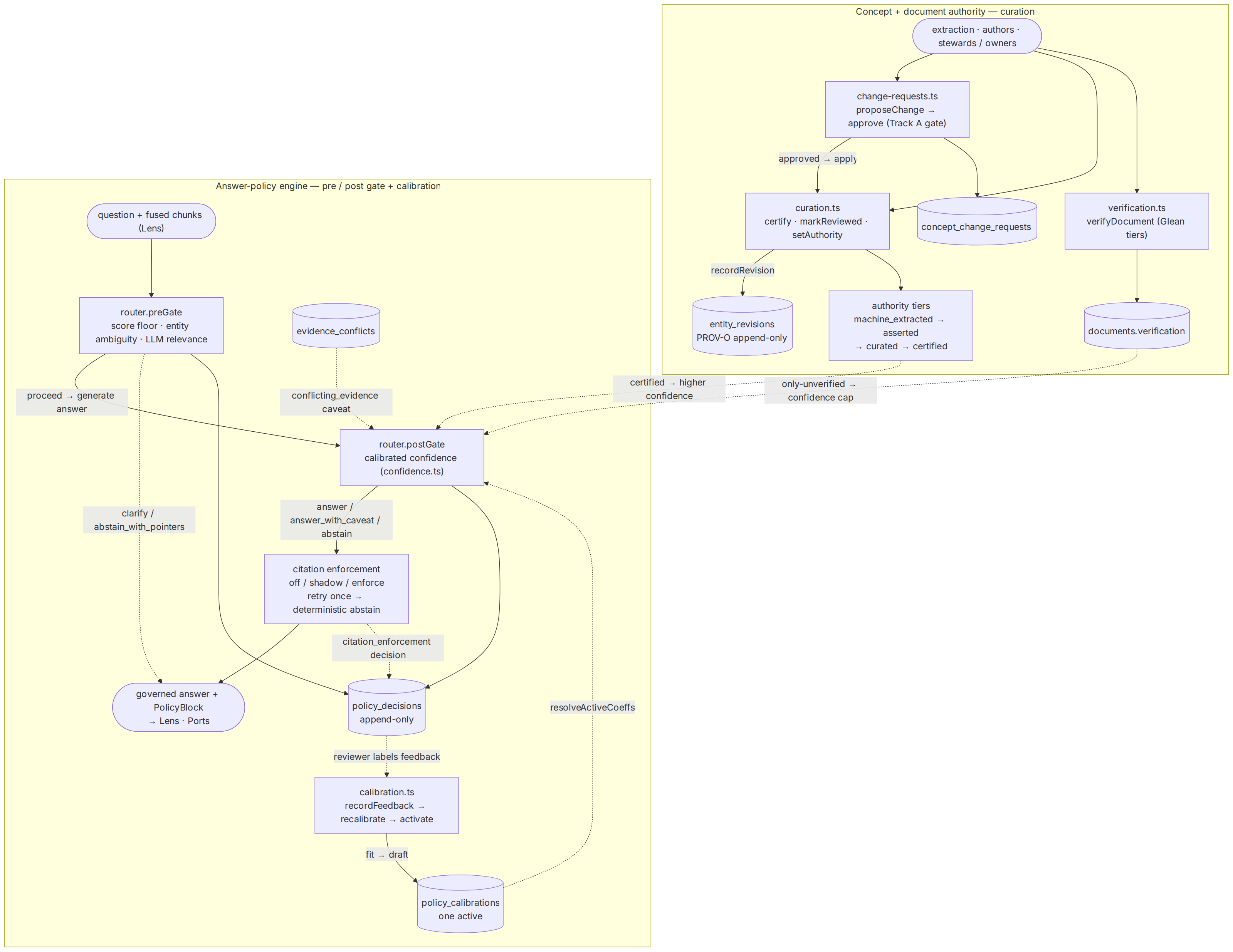
Two write paths feed the graph: schema-level and destructive edits are gated through change-requests.ts (propose → owner/steward approve → apply), while every mutation and document verification is stamped into append-only entity_revisions (PROV-O) and documents.verification, escalating each concept up the authority ladder machine_extracted → asserted → curated → certified. At answer time that same governance state flows into the policy engine: router.preGate screens retrieval before generation (score floor, deterministic entity ambiguity, an optional LLM relevance/ambiguity call), and router.postGate scores calibrated confidence from confidence.ts — hard-capping it below the answer floor when only unverified sources are cited and adding caveats from evidence_conflicts. The pre- and post-verdicts (proceed/clarify/abstain and answer/answer_with_caveat/abstain) are logged append-only to policy_decisions, which closes the tuning loop: calibration.ts labels those decisions from reviewer feedback, refits a logistic model, and activates one policy_calibrations row that resolveActiveCoeffs feeds back into every future postGate.
Warrant — governance and answer policy
Warrant governs two things at once: the authority and revision history of every concept and document, and the pre/post-gate answer-policy engine whose calibrated confidence — hard-capped for unverified sources — decides answer, caveat, abstain, or clarify.
Downloads

Concepts
- System diagrams
- Warrant — governance and answer policy
- Concept + document authority — curation
- Warrant
- Answer-policy engine — pre / post gate + calibration
Keywords
- machine_extracted → asserted
- calibrated confidence (confidence.ts)
- clarify / abstain_with_pointers
- answer / answer_with_caveat / abstain
- citation_enforcement decision
- conflicting_evidence caveat
- authority tiers
- → curated → certified
- PROV-O append-only
- approved → apply
- one active
- → Lens · Ports
- citation enforcement
- off / shadow / enforce
- fit → draft
- extraction · authors · stewards / owners
- proposeChange → approve (Track A gate)
- certify · markReviewed · setAuthority
- verifyDocument (Glean tiers)
- question + fused chunks (Lens)
- score floor · entity ambiguity · LLM relevance
- recordFeedback → recalibrate → activate
- governed answer + PolicyBlock
- proceed → generate answer
- retry once → deterministic abstain
- reviewer labels feedback
- only-unverified → confidence cap
- certified → higher confidence
- concept_change_requests
- entity_revisions
- documents.verification
- router.preGate
- router.postGate
- policy_decisions
- policy_calibrations
- evidence_conflicts
- recordRevision
- append-only
- resolveActiveCoeffs
Source and generation provenance
Status: current
Generated at: 2026-08-12T23:43:28.542Z
Source hash: 2f146ef27a582b7d2c33112796d692006b9a9d37498d648b00c81cb5bb1aa8b2
Metadata payload hash: 7c5955b9a70b0f42111477ead425be216a12e9ec1b6370a147ba055bb8598432
Canonical appearance
src/app/(docs)/docs/concepts/system-diagrams/page.tsx:212 route /docs/concepts/system-diagrams
All appearances
mirror—docs/architecture/system-diagrams.md:272canonical—src/app/(docs)/docs/concepts/system-diagrams/page.tsx:212route/docs/concepts/system-diagrams
Generation versions
App: eli-ai 0.1.0
Mermaid: 11.16.0 · Mermaid CLI: 11.16.0
Node: v26.3.1 · Yarn: 4.17.1
Renderer config hash: 68c10966fe84406ee626034d58bfabd555df9f65f691204b7c46db24038da101
Renderer theme hash: c80287a78d80ad63d27bd5ca348b2ef9a7e2f44da289e436be6484ea28a1b033
Adapter versions: diagramGenerator=2, drawioFlowchart=1, drawioGantt=1, drawioSequence=1, drawioState=1
Full sidecar JSON: warrant-governance-and-answer-policy-2f146ef2.json
Key modules & tables
- src/server/graph/curation.ts — recordRevision, certifyEntity, markReviewed, setAuthority; authority tiers (machine_extracted→asserted→curated→certified) + lifecycle + review SLAs
- src/server/graph/change-requests.ts — proposeChange / approveChangeRequest / rejectChangeRequest (Track A gated review, claim → apply → stamp appliedAt)
- src/server/vault/verification.ts — verifyDocument (Glean verified/certified tiers, next_verify_at)
- src/server/policy/router.ts — preGate (floor · entity ambiguity · LLM relevance) and postGate (4-verdict engine + Glean confidence cap)
- src/server/policy/confidence.ts + calibration.ts — logistic calibrated confidence + feedback→recalibrate→activate tuning loop (resolveActiveCoeffs)
- Tables: entity_revisions, concept_change_requests, documents.verification, policy_decisions, policy_calibrations, evidence_conflicts (all workspace-scoped, FORCE-RLS)
4LineageProvenance & traceability
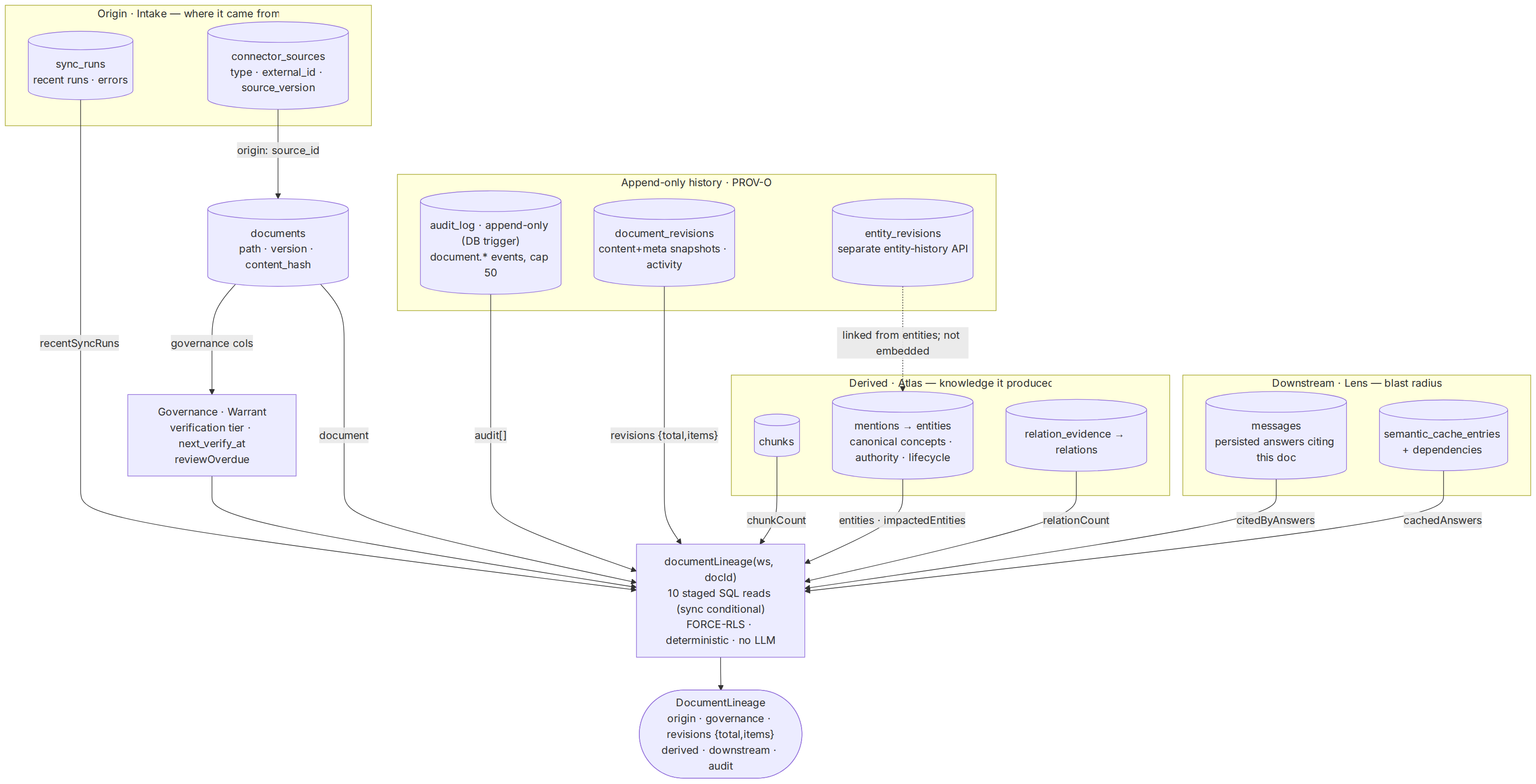
documentLineage(workspaceId, docId) performs ten staged, tenant-isolated SQL reads (the recent-sync read is conditional) for one live document. It returns origin, verification/review state, the total and newest 50 document revision summaries, the newest 50 document audit events, derived chunk/entity/relation counts, cited-answer count, dependent cache entries, and impacted canonical entities. Entity revision history remains available through the separate entity revisions API and is not embedded in DocumentLineage. REST, MCP, the workspace BFF, and the document UI consume the same bounded payload.
Lineage — provenance and blast radius
DocumentLineage unifies origin, governance, bounded revision/audit summaries, derivation, and downstream blast radius without a model call.
Downloads

Concepts
- System diagrams
- Lineage — provenance and blast radius
- Append-only history · PROV-O
- Downstream · Lens — blast radius
- Lineage
- Origin · Intake — where it came from
- Derived · Atlas — knowledge it produced
Keywords
- separate entity-history API
- FORCE-RLS · deterministic · no LLM
- origin: source_id
- type · external_id · source_version
- path · version · content_hash
- verification tier · next_verify_at
- relation_evidence → relations
- recent runs · errors
- Governance · Warrant
- DB trigger
- mentions → entities
- governance cols
- revisions {total,items}
- linked from entities
- not embedded
- content+meta snapshots · activity
- canonical concepts · authority · lifecycle
- persisted answers citing this doc
- documentLineage(ws, docId)
- origin · governance · revisions {total,items}
- derived · downstream · audit
- entities · impactedEntities
- connector_sources
- sync_runs
- document_revisions
- entity_revisions
- semantic_cache_entries
- documents
- reviewOverdue
- chunks
- messages
- dependencies
- DocumentLineage
- total,items
- recentSyncRuns
- document
- audit[]
- chunkCount
- relationCount
- citedByAnswers
Source and generation provenance
Status: current
Generated at: 2026-08-12T23:39:57.028Z
Source hash: caf14625e044e75d702a8c7f42b68ac9231fc199599a1e5669b0b9b9a6f115fc
Metadata payload hash: 13360a04c3862414d72e2dba73d9d05871a566e9ac3ce097aef722ee8f598522
Canonical appearance
src/app/(docs)/docs/concepts/system-diagrams/page.tsx:256 route /docs/concepts/system-diagrams
All appearances
mirror—docs/architecture/system-diagrams.md:341canonical—src/app/(docs)/docs/concepts/system-diagrams/page.tsx:256route/docs/concepts/system-diagrams
Generation versions
App: eli-ai 0.1.0
Mermaid: 11.16.0 · Mermaid CLI: 11.16.0
Node: v26.3.1 · Yarn: 4.17.1
Renderer config hash: 68c10966fe84406ee626034d58bfabd555df9f65f691204b7c46db24038da101
Renderer theme hash: c80287a78d80ad63d27bd5ca348b2ef9a7e2f44da289e436be6484ea28a1b033
Adapter versions: diagramGenerator=2, drawioFlowchart=1, drawioGantt=1, drawioSequence=1, drawioState=1
Full sidecar JSON: lineage-provenance-and-blast-radius-caf14625.json
Key modules & tables
- src/server/lineage/index.ts — deterministic 10-stage assembler; no LLM, network, or filesystem I/O
- src/server/vault/revisions.ts — append-only document revisions with snapshot/diff/activity
- audit_log — bounded document.* event trail
- src/server/graph/curation.ts + entity revision endpoint — separate concept history
- documents + connector_sources + sync_runs — origin and governance
- messages, semantic-cache dependencies, mentions/entities — downstream impact
5ConduitThe live-data layer
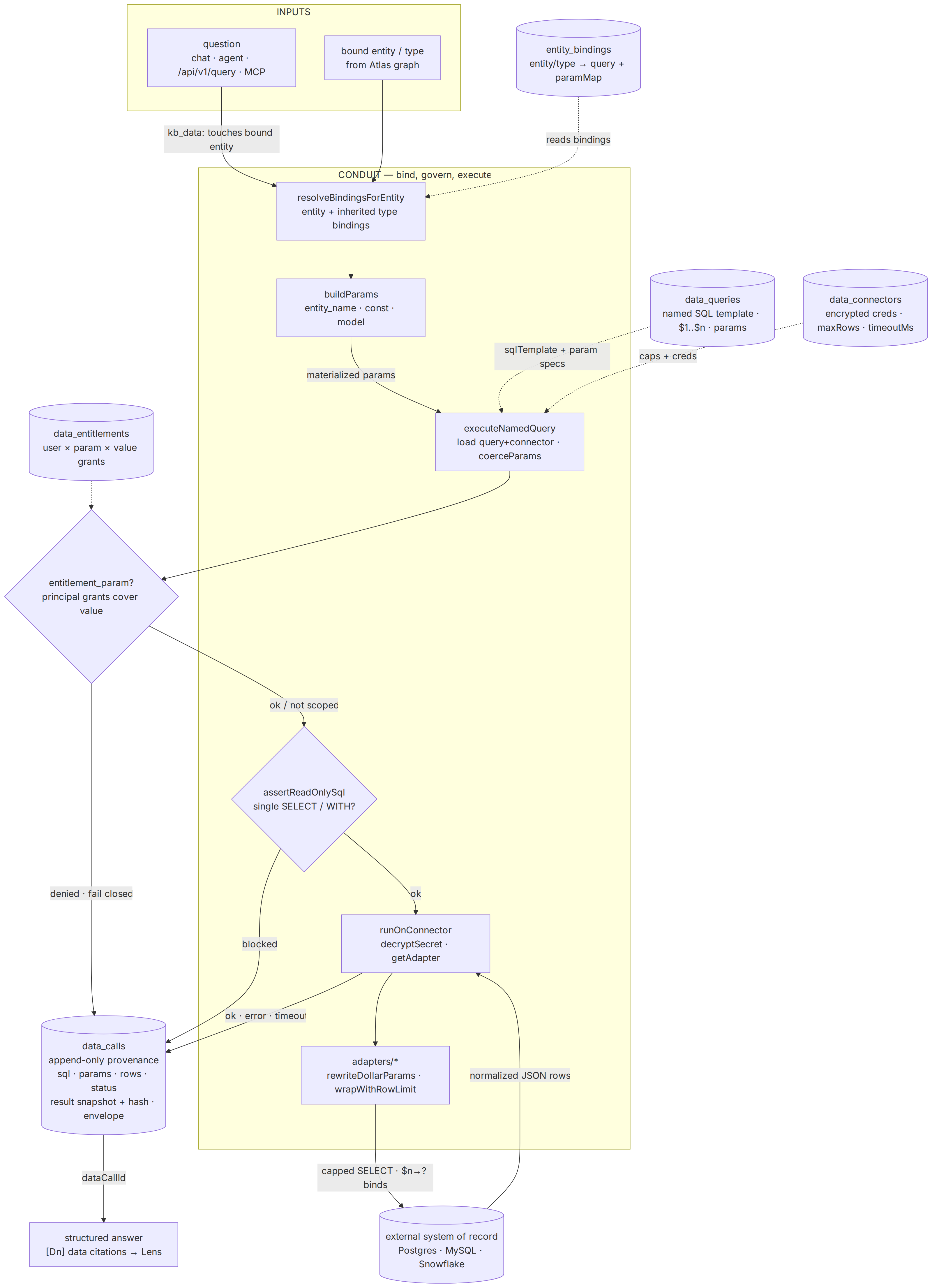
Conduit is the bridge from the semantic graph to systems of record. When a question touches an entity, resolveBindingsForEntity (bindings.ts) gathers the entity's own bindings plus the ones inherited from its type, buildParams materializes each parameter from the binding's paramMap (entity_name, const, or model-supplied), and executeNamedQuery (executor.ts) loads the matching data_queries domain component and its data_connectors row inside one short RLS transaction, then coerces params against each DataParamSpec. The governed tail runs assertReadOnlySql (single SELECT/WITH only), decrypts the credential at call time, and dispatches to the engine adapter (postgres/mysql/snowflake) which rewrites $1..$n placeholders to the driver bind style and caps the result by maxRows and timeoutMs — all strictly outside any tenant transaction, since connector SQL is network I/O. Every execution appends an append-only data_calls provenance row (executed SQL, params, row count, duration, status), and that row's dataCallId is the anchor behind the [Dn] data citation handed into the grounded answer.
Conduit — governed live data
Conduit: a bound entity plus a question resolves through entity_bindings to a governed named query, runs read-only against a system of record via the per-engine adapter, and every call — ok, error, timeout, or blocked — appends a data_calls row that becomes a [Dn] citation.
Downloads

Concepts
- System diagrams
- Conduit — governed live data
- CONDUIT — bind, govern, execute
- Inputs
- Conduit
Keywords
- named SQL template · $1..$n · params
- chat · agent · · MCP
- Postgres · MySQL · Snowflake
- entity_name · const · model
- kb_data: touches bound entity
- bound entity / type
- from Atlas graph
- single SELECT / WITH?
- → query + paramMap
- append-only provenance
- reads bindings
- materialized params
- caps + creds
- denied · fail closed
- ok / not scoped
- normalized JSON rows
- ok · error · timeout
- entity + inherited type bindings
- load query+connector · coerceParams
- decryptSecret · getAdapter
- rewriteDollarParams · wrapWithRowLimit
- encrypted creds · maxRows · timeoutMs
- sql · params · rows · status
- result snapshot + hash · envelope
- external system of record
- sqlTemplate + param specs
- principal grants cover value
- user × param × value grants
- capped SELECT · $n→? binds
- entity_bindings
- data_queries
- data_connectors
- data_calls
- entitlement_param?
- data_entitlements
- /api/v1/query
- entity/type
- question
- buildParams
- executeNamedQuery
Source and generation provenance
Status: current
Generated at: 2026-08-12T23:37:30.526Z
Source hash: cda4d617212fac72247c1c39543f5be26d5be55ec58744d622db822200a6f132
Metadata payload hash: fe20151aec2109ae985acd4f8116088584a6138c6638d001a90361ec86b73a2f
Canonical appearance
src/app/(docs)/docs/concepts/system-diagrams/page.tsx:295 route /docs/concepts/system-diagrams
All appearances
mirror—docs/architecture/system-diagrams.md:406canonical—src/app/(docs)/docs/concepts/system-diagrams/page.tsx:295route/docs/concepts/system-diagrams
Generation versions
App: eli-ai 0.1.0
Mermaid: 11.16.0 · Mermaid CLI: 11.16.0
Node: v26.3.1 · Yarn: 4.17.1
Renderer config hash: 68c10966fe84406ee626034d58bfabd555df9f65f691204b7c46db24038da101
Renderer theme hash: c80287a78d80ad63d27bd5ca348b2ef9a7e2f44da289e436be6484ea28a1b033
Adapter versions: diagramGenerator=2, drawioFlowchart=1, drawioGantt=1, drawioSequence=1, drawioState=1
Full sidecar JSON: conduit-governed-live-data-cda4d617.json
Key modules & tables
- src/server/data/bindings.ts — resolveBindingsForEntity + buildParams: the semantic→data join (entity/type → query + paramMap, entity_name/const/model sources)
- src/server/data/executor.ts — executeNamedQuery, assertReadOnlySql (SELECT/WITH-only gate), recordDataCall: the governed gate that always writes provenance
- src/server/data/adapters/* — getAdapter, wrapWithRowLimit, rewriteDollarParams; postgres.ts / mysql.ts / snowflake.ts are the only driver-touching modules
- data_connectors (table) — AES-256-GCM encrypted creds, maxRows, timeoutMs, enabled, allowRawSql escape hatch
- data_queries (table) — named parameterized read-only SQL templates ($1..$n) with DataParamSpec[] param specs (the 'domain components')
- entity_bindings + data_calls (tables) — entity/type→query paramMap bindings; append-only [Dn] provenance (sqlText, paramsUsed, rowCount, durationMs, status ok/error/timeout/blocked, executedBy, run/conversation linkage)
6LensRetrieve & answer
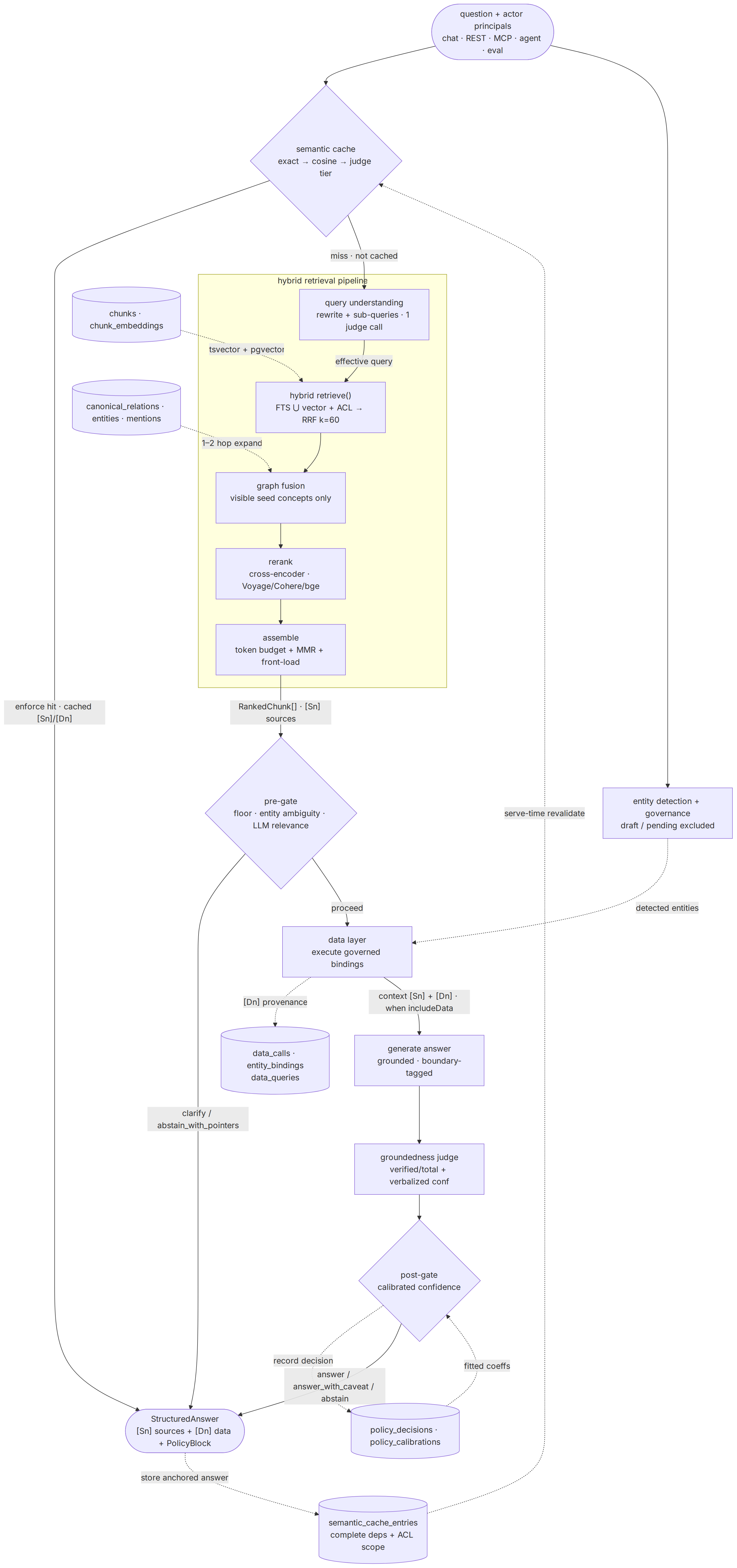
The entry boundary resolves an explicit content-ACL context. Cache keys include that authorization scope and every stored answer must record its complete cited dependency set; serve revalidates authorization and hashes. On a miss, the same actor principals filter FTS/vector candidates and document-derived graph seeds before fusion, reranking, and context assembly. The pre-gate can clarify or abstain without generation; otherwise governed data calls add [Dn] provenance, grounded generation produces [Sn]/[Dn] claims, and groundedness/conflict signals feed the calibrated post-gate. Chat, structured REST, MCP, native agents, and evals propagate the same ACL contract.
Lens — retrieval and governed answers
Actor-scoped cache and retrieval feed graph fusion, ranking, policy, optional live data, and a cited structured result.
Downloads

Concepts
- System diagrams
- Lens — retrieval and governed answers
- hybrid retrieval pipeline
- Lens
Keywords
- chunks · chunk_embeddings
- canonical_relations · entities · mentions
- clarify / abstain_with_pointers
- policy_decisions · policy_calibrations
- answer / answer_with_caveat / abstain
- semantic cache
- serve-time revalidate
- miss · not cached
- query understanding
- hybrid retrieve()
- effective query
- graph fusion
- tsvector + pgvector
- 1–2 hop expand
- data layer
- detected entities
- [Dn] provenance
- generate answer
- groundedness judge
- verbalized conf
- calibrated confidence
- fitted coeffs
- record decision
- store anchored answer
- question + actor principals
- exact → cosine → judge tier
- complete deps + ACL scope
- enforce hit · cached [Sn]/[Dn]
- rewrite + sub-queries · 1 judge call
- FTS ⋃ vector + ACL → RRF k=60
- visible seed concepts only
- token budget + MMR + front-load
- entity detection + governance
- draft / pending excluded
- floor · entity ambiguity · LLM relevance
- RankedChunk[] · [Sn] sources
- execute governed bindings
- grounded · boundary-tagged
- context [Sn] + [Dn] · when includeData
- chat · REST · MCP · agent · eval
Source and generation provenance
Status: current
Generated at: 2026-08-12T23:39:52.546Z
Source hash: 9f35ef38dbff5f310a1fec47756e94c8356435a7b325d0b9e03047997b952139
Metadata payload hash: 3bd8217e98283f0936085c3a1e2ea185d480e242c4210042ea030cbd41a45545
Canonical appearance
src/app/(docs)/docs/concepts/system-diagrams/page.tsx:333 route /docs/concepts/system-diagrams
All appearances
mirror—docs/architecture/system-diagrams.md:471canonical—src/app/(docs)/docs/concepts/system-diagrams/page.tsx:333route/docs/concepts/system-diagrams
Generation versions
App: eli-ai 0.1.0
Mermaid: 11.16.0 · Mermaid CLI: 11.16.0
Node: v26.3.1 · Yarn: 4.17.1
Renderer config hash: 68c10966fe84406ee626034d58bfabd555df9f65f691204b7c46db24038da101
Renderer theme hash: c80287a78d80ad63d27bd5ca348b2ef9a7e2f44da289e436be6484ea28a1b033
Adapter versions: diagramGenerator=2, drawioFlowchart=1, drawioGantt=1, drawioSequence=1, drawioState=1
Full sidecar JSON: lens-retrieval-and-governed-answers-9f35ef38.json
Key modules & tables
- src/server/authz/content-acl.ts — principal context and SQL predicates
- src/server/query/structured.ts — cache → retrieve → policy → data → generation → policy
- src/server/retrieval/index.ts + pipeline.ts + graph-fusion.ts — actor-filtered FTS/vector/graph path
- src/server/cache/semantic-cache.ts — ACL-scoped keys, all-or-none dependencies and serve validation
- src/server/policy/router.ts + conversations/groundedness.ts — verdict and evidence checks
- Tables: cache entries/dependencies, chunks/embeddings, canonical graph, data calls, policy decisions
7CrucibleEvaluate & measure
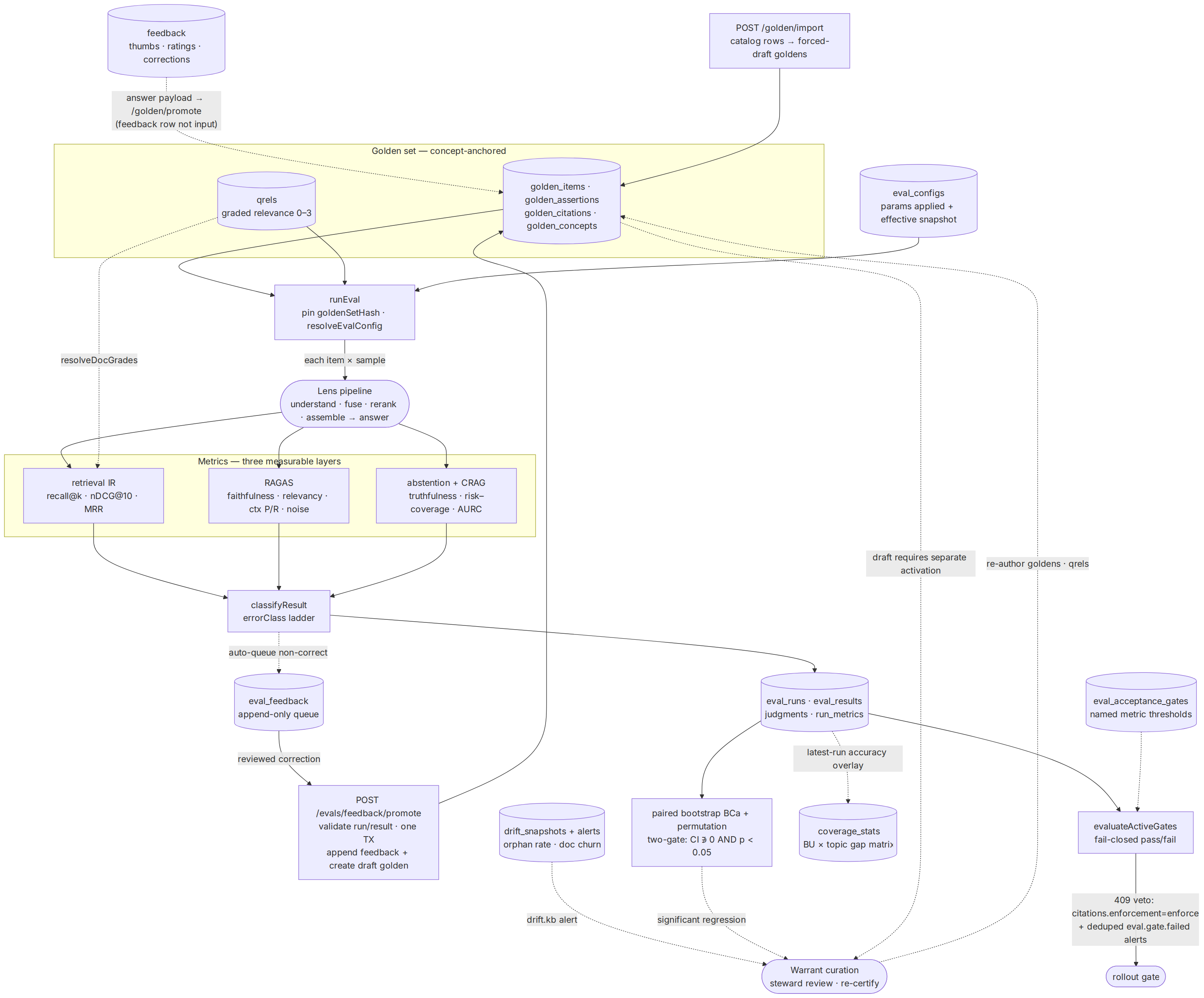
runEval pins the active golden set and applies an eval_configs row, then routes each item through the real Lens retrieve-and-answer pipeline. Target and judge snapshot ids are indexed foreign keys to immutable config_snapshots. Results carry deterministic error classes and roll up retrieval, answer-quality, abstention, concept, and significance measures. The two promotion paths remain distinct: /golden/promote accepts a supplied answer payload and does not consume a feedback row; authenticated POST /evals/feedback/promote validates a reviewed correction's run/result ownership, then atomically appends eval_feedback and creates its draft golden item, assertions, citations, and tags. A separate steward action must activate either draft, keeping the loop human-controlled.
Crucible — evaluation and quality control
Concept-anchored evaluation pins configuration lineage, measures the real Lens pipeline, and promotes reviewed corrections only as draft goldens.
Downloads

Concepts
- System diagrams
- Crucible — evaluation and quality control
- Golden set — concept-anchored
- Metrics — three measurable layers
- Crucible
Keywords
- judgments · run_metrics
- drift.kb alert
- golden_items · golden_assertions
- golden_citations · golden_concepts
- eval_runs · eval_results
- deduped eval.gate.failed alerts
- drift_snapshots + alerts
- graded relevance 0–3
- feedback row not input
- answer payload →
- Lens pipeline
- each item × sample
- retrieval IR
- abstention + CRAG
- append-only queue
- validate · one TX
- reviewed correction
- named metric thresholds
- rollout gate
- BU × topic gap matrix
- orphan rate · doc churn
- Warrant curation
- significant regression
- thumbs · ratings · corrections
- params applied + effective snapshot
- catalog rows → forced-draft goldens
- pin goldenSetHash · resolveEvalConfig
- recall@k · nDCG@10 · MRR
- faithfulness · relevancy · ctx · noise
- truthfulness · risk–coverage · AURC
- append feedback + create draft golden
- paired bootstrap BCa + permutation
- two-gate: CI ∌ 0 AND p <
- latest-run accuracy overlay
- steward review · re-certify
- draft requires separate activation
- re-author goldens · qrels
- eval_configs
- eval_feedback
- eval_acceptance_gates
Source and generation provenance
Status: current
Generated at: 2026-08-12T23:37:46.765Z
Source hash: d72bba9d401008417665c3bb60732d8ef46aca2af6ed1fc5e40a3505fec4ed35
Metadata payload hash: 05824a2bcb18829d54c6e1eb17d34b1c90a59dbe67a8f26e7949d69b959742c4
Canonical appearance
src/app/(docs)/docs/concepts/system-diagrams/page.tsx:362 route /docs/concepts/system-diagrams
All appearances
mirror—docs/architecture/system-diagrams.md:526canonical—src/app/(docs)/docs/concepts/system-diagrams/page.tsx:362route/docs/concepts/system-diagrams
Generation versions
App: eli-ai 0.1.0
Mermaid: 11.16.0 · Mermaid CLI: 11.16.0
Node: v26.3.1 · Yarn: 4.17.1
Renderer config hash: 68c10966fe84406ee626034d58bfabd555df9f65f691204b7c46db24038da101
Renderer theme hash: c80287a78d80ad63d27bd5ca348b2ef9a7e2f44da289e436be6484ea28a1b033
Adapter versions: diagramGenerator=2, drawioFlowchart=1, drawioGantt=1, drawioSequence=1, drawioState=1
Full sidecar JSON: crucible-evaluation-and-quality-control-d72bba9d.json
Key modules & tables
- src/server/evals/golden.ts — golden items, assertions, citations, concepts, qrels, and draft activation
- src/server/evals/runner.ts — applied eval config, Lens execution, results, judgments, metrics, and pinned target/judge snapshots
- drizzle/0033_eval_snapshot_fks.sql — indexed target/judge snapshot foreign keys with ON DELETE SET NULL
- src/server/evals/metrics/ — retrieval, RAGAS, abstention/AURC, and significance metrics
- src/server/evals/feedback-classify.ts + evals/feedback/promote route — deterministic classification and atomic reviewed-correction promotion
- src/server/evals/drift.ts + src/server/coverage/index.ts — corpus drift, alerts, and coverage overlays
8PortsProgrammatic surfaces
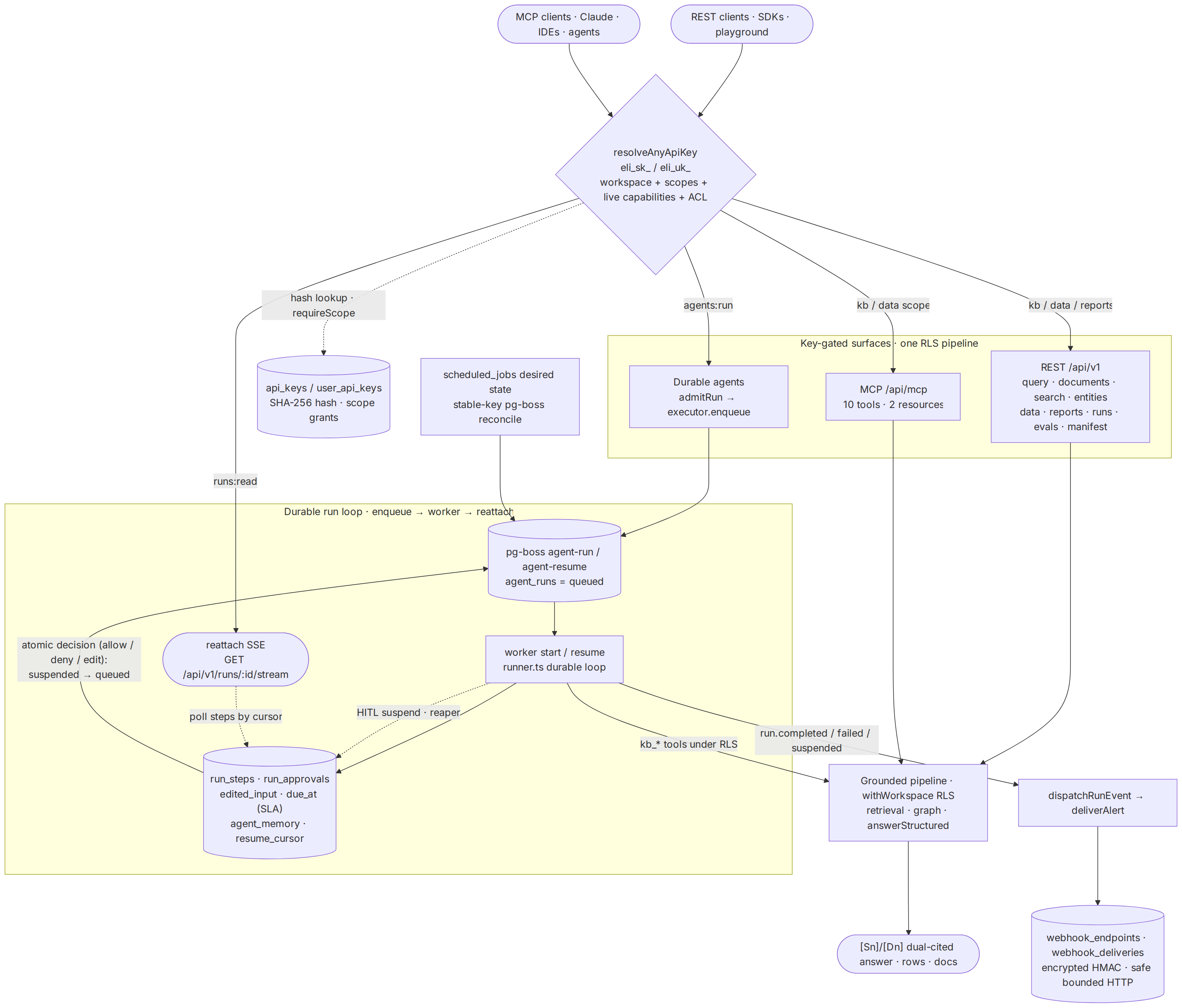
Workspace keys bind one workspace; user keys resolve a live membership and capability set, with X-Workspace-Id when required. Both feed REST and the stateless eight-tool/two-resource MCP server under FORCE-RLS and an actor content-ACL context. Agent starts return 202 after an admitted queued outbox row; a stable agent-run identity plus boot/minute reconciliation repairs an interrupted broker handoff, and clients reattach through DB-backed SSE. HITL decisions atomically move suspended runs back to queued and the agent-resume worker idempotently claims the persisted cursor. All schedule kinds use scheduled_jobs desired state and stable-key reconciliation. Run events deliver through encrypted webhook secrets and the shared address-pinned, redirect-revalidating, bounded HTTP client.
Ports — REST, MCP, durable agents, and events
REST, MCP, schedules, durable runs/continuations, reattachment, and safe webhook delivery share one authenticated RLS control plane.
Downloads

Concepts
- System diagrams
- Key-gated surfaces · one RLS pipeline
- Ports
- Ports — REST, MCP, durable agents, and events
- Durable run loop · enqueue → worker → reattach
Keywords
- kb_* tools under RLS
- reattach SSE
- MCP clients · Claude · IDEs · agents
- stable-key pg-boss reconcile
- Grounded pipeline · withWorkspace RLS
- encrypted HMAC · safe bounded HTTP
- pg-boss agent-run / agent-resume
- eli_sk_ / eli_uk_
- agent_runs = queued
- runner.ts durable loop
- api_keys / user_api_keys
- scheduled_jobs desired state
- webhook_endpoints · webhook_deliveries
- admitRun → executor.enqueue
- run.completed / failed / suspended
- Durable agents
- worker start / resume
- GET :id/stream
- kb / data / reports
- kb / data scope
- allow / deny / edit
- suspended → queued
- HITL suspend · reaper
- poll steps by cursor
- REST clients · SDKs · playground
- workspace + scopes + live capabilities + ACL
- SHA-256 hash · scope grants
- retrieval · graph · answerStructured
- dispatchRunEvent → deliverAlert
- query · documents · search · entities
- hash lookup · requireScope
- atomic decision (allow / deny / edit)
- MCP
- /api/v1
- /api/mcp
- /api/v1/runs
- resolveAnyApiKey
- Sn
- Dn
- REST
Source and generation provenance
Status: current
Generated at: 2026-08-12T23:40:51.634Z
Source hash: 6662b869be5ec7937a335aab8457df7bc68418af9ba412ffec22f39c4089f3e8
Metadata payload hash: e36785c18d608f4f8ced8005783fc9fd03f9f58b7806d23a66cfea6c31621238
Canonical appearance
src/app/(docs)/docs/concepts/system-diagrams/page.tsx:425 route /docs/concepts/system-diagrams
All appearances
mirror—docs/architecture/system-diagrams.md:624canonical—src/app/(docs)/docs/concepts/system-diagrams/page.tsx:425route/docs/concepts/system-diagrams
Generation versions
App: eli-ai 0.1.0
Mermaid: 11.16.0 · Mermaid CLI: 11.16.0
Node: v26.3.1 · Yarn: 4.17.1
Renderer config hash: 68c10966fe84406ee626034d58bfabd555df9f65f691204b7c46db24038da101
Renderer theme hash: c80287a78d80ad63d27bd5ca348b2ef9a7e2f44da289e436be6484ea28a1b033
Adapter versions: diagramGenerator=2, drawioFlowchart=1, drawioGantt=1, drawioSequence=1, drawioState=1
Full sidecar JSON: ports-rest-mcp-durable-agents-and-events-6662b869.json
Key modules & tables
- src/server/apikeys + user-keys — hashed grants, workspace resolution and live capability narrowing
- src/app/api/v1 + src/server/openapi/spec.ts — 56 documented REST operations
- src/app/api/mcp + src/server/mcp/server.ts — ten tools and two resources
- src/server/agents/executor.ts + starts.ts + continuations.ts + runner.ts + reattach.ts — durable start/resume/stream lifecycle
- src/server/jobs/index.ts — 15 queues and scheduled_jobs desired-state reconciliation
- src/server/alerts/webhooks.ts + network/safe-fetch.ts — encrypted signing secret and safe bounded delivery
See it end to end
Searchable diagram catalog
Search every generated diagram metadata record and open route/source appearances plus five downloads (draw.io, SVG, PNG, Mermaid source, and JSON metadata).
234 of 234 diagrams
Page 1 of 10
Agent and API integration overview
Agent and API integration overview maps the principal capabilities, boundaries, and data paths in this architecture.
Concepts
Keywords
+17 more
- Canonical
- Canonical: Source
- Mirrors
- None
Downloads

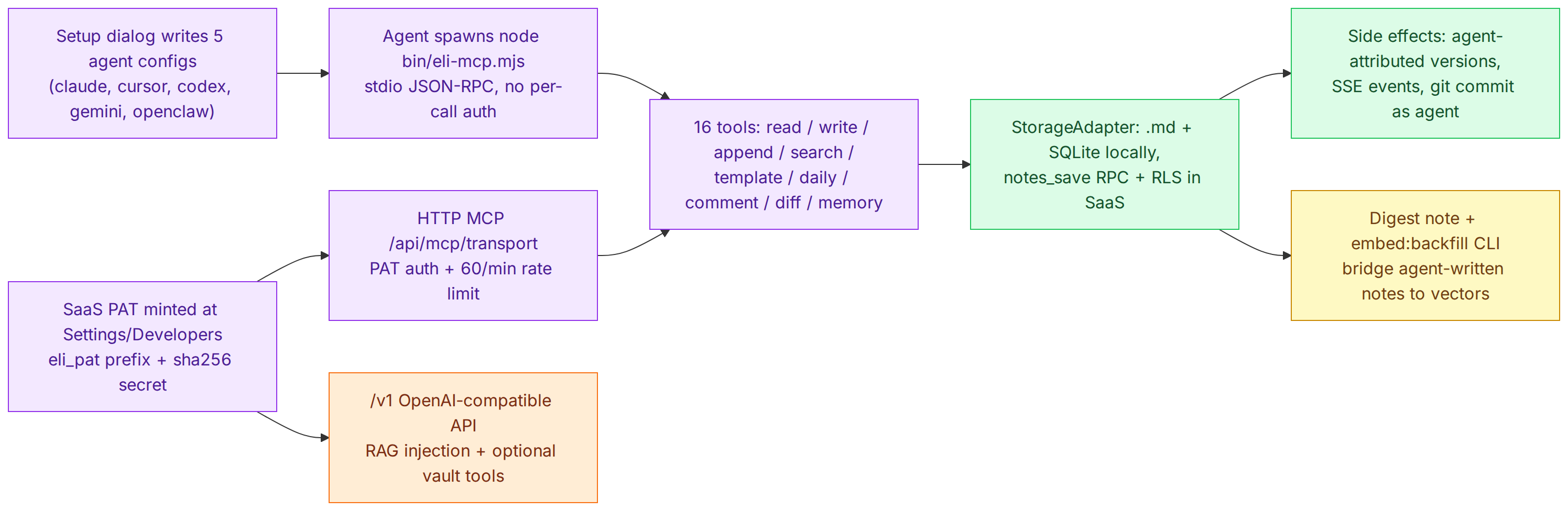
Agent memory — lifecycle
Memory is recalled at run start, updated during the run, and persists to the next one.
Concepts
Keywords
+3 more
- Mirrors
- None
Downloads

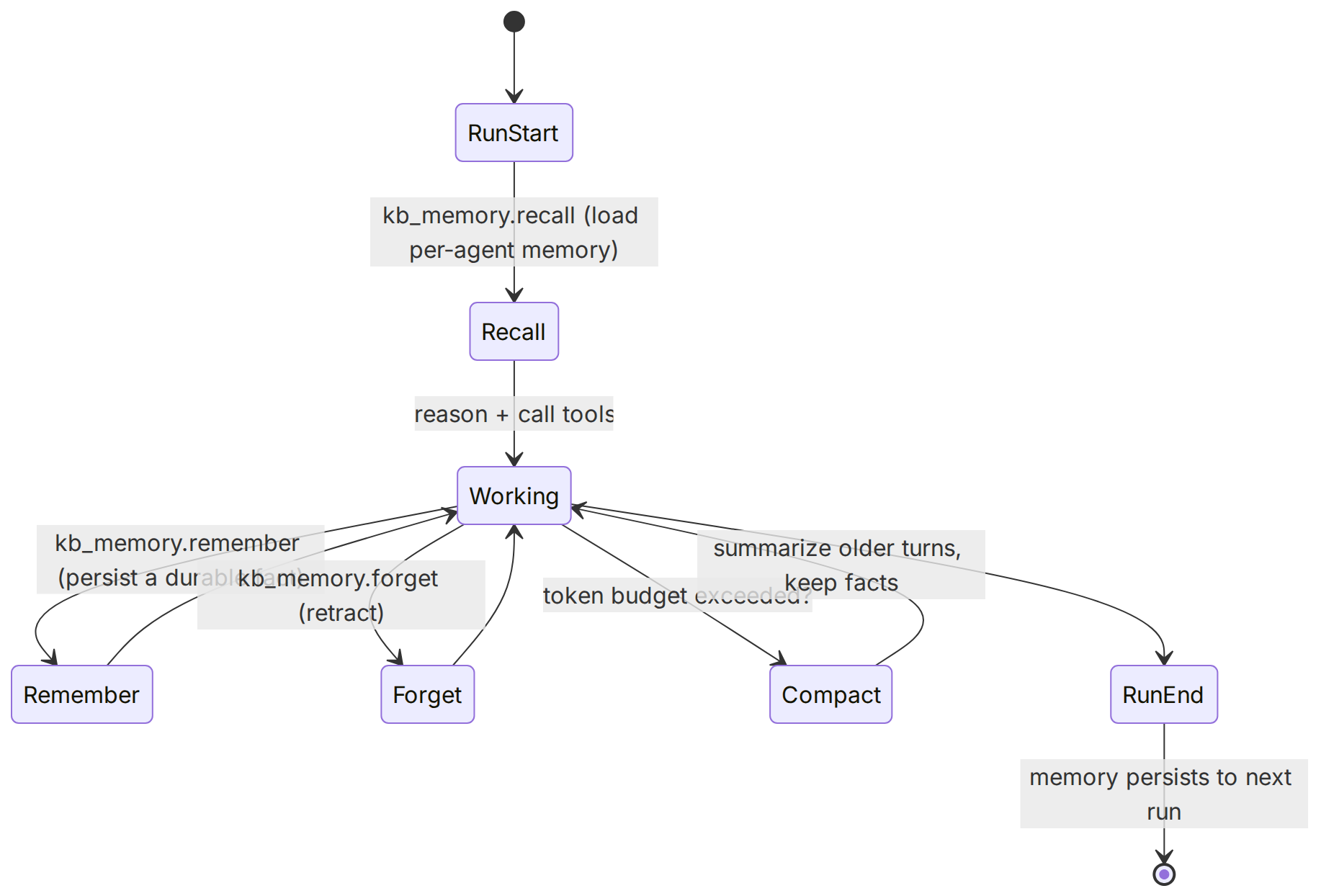
Agent platform (durable, provider-agnostic)
Agent platform (durable, provider-agnostic) maps the principal capabilities, boundaries, and data paths in this architecture.
Concepts
Keywords
+15 more
- Canonical
- Canonical: Source
- Mirrors
- None
Downloads

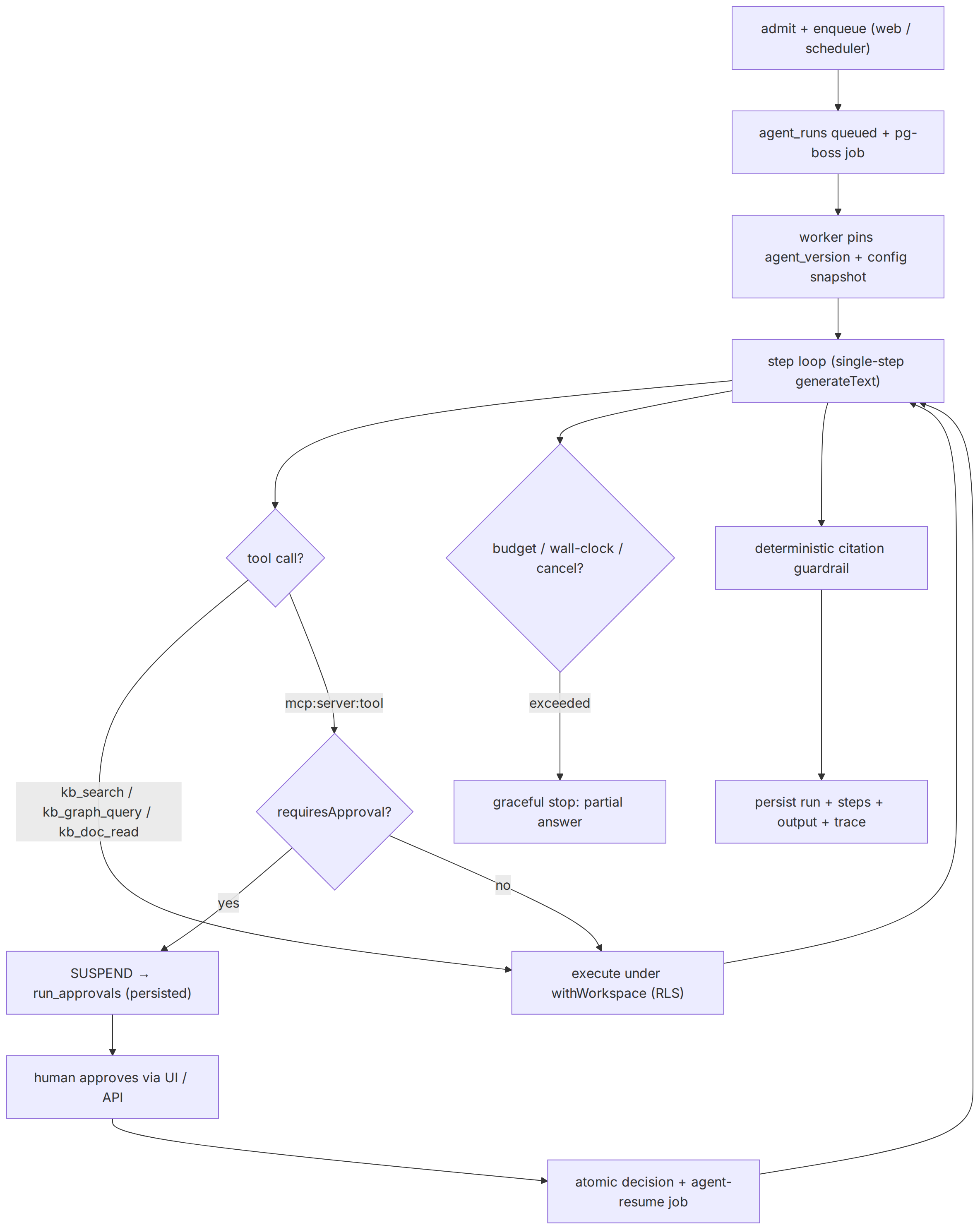
Agent surface — detailed system view
Maps local stdio and hosted HTTP MCP transports from external agents through authenticated tool handlers into workspace-scoped storage and AI services.
Concepts
Keywords
+23 more
- Canonical
- Canonical: Source
- Mirrors
- None
Downloads

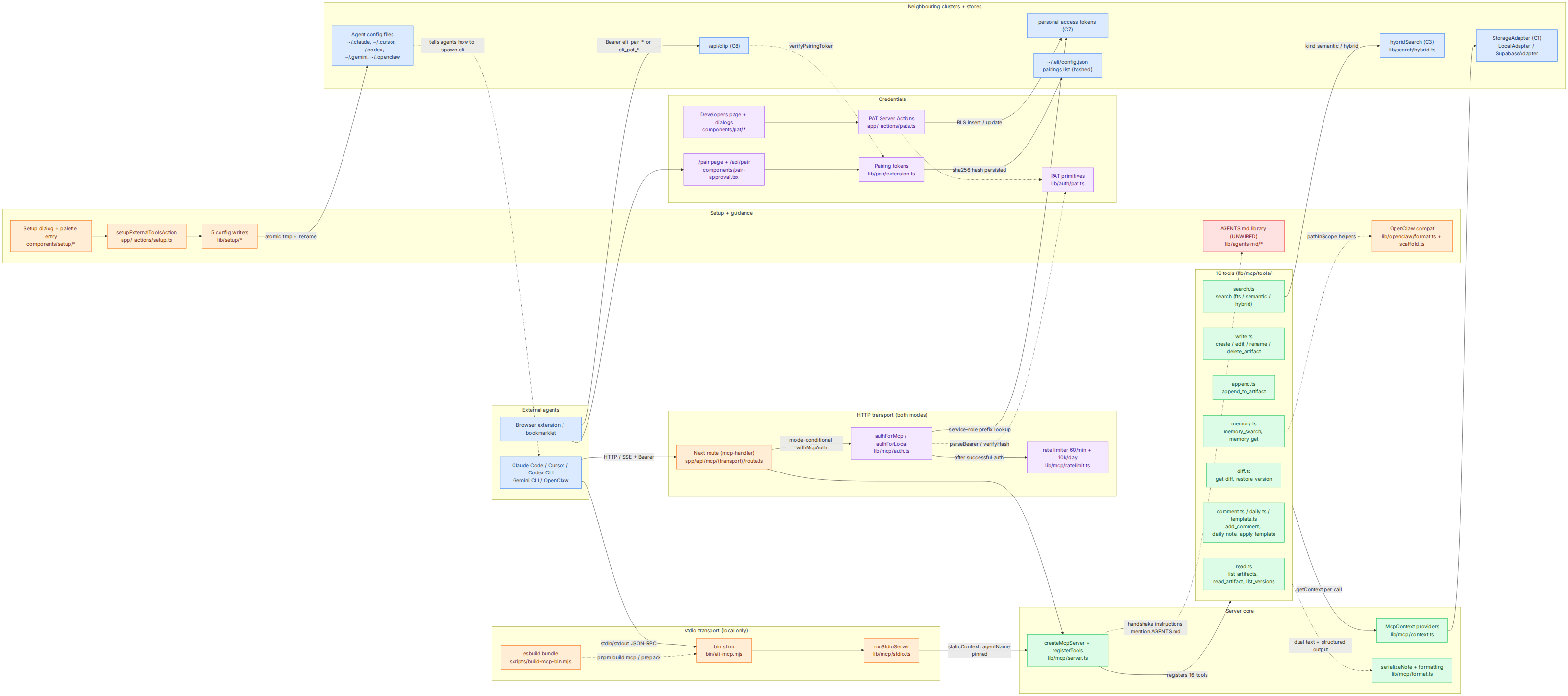
Agent surface — simplified data flow
Agent surface — simplified data flow maps the principal capabilities, boundaries, and data paths in this architecture.
Concepts
Keywords
+13 more
- Canonical
- Canonical: Source
- Mirrors
- None
Downloads

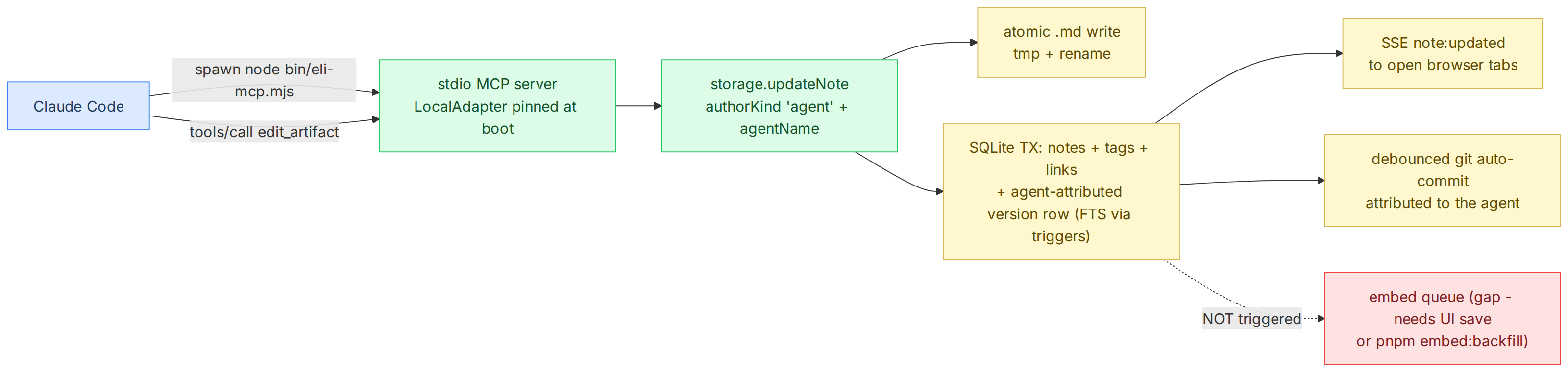
Agent surface — simplified system view
Agent surface — simplified system view maps the principal capabilities, boundaries, and data paths in this architecture.
Concepts
Keywords
+18 more
- Canonical
- Canonical: Source
- Mirrors
- None
Downloads


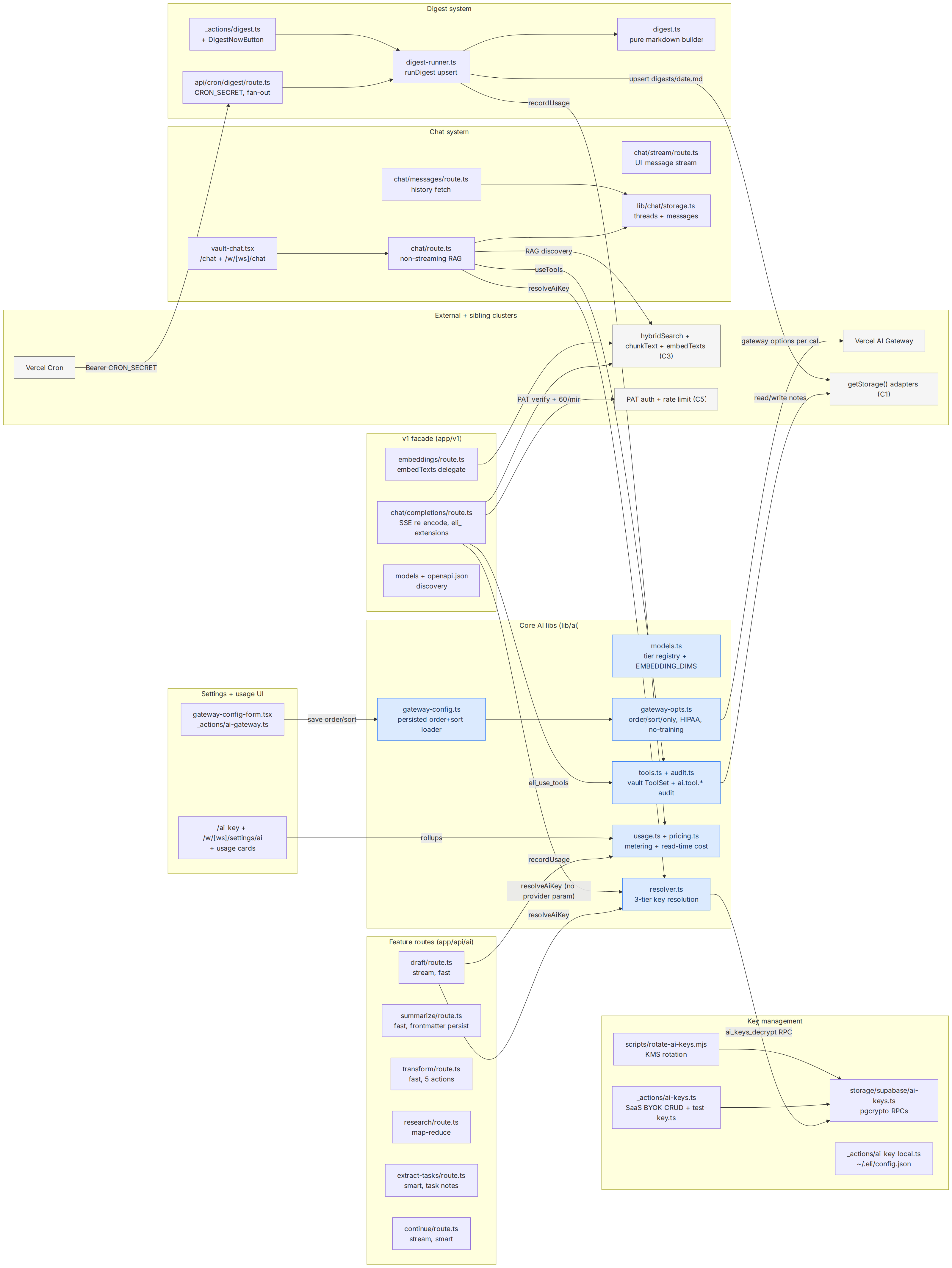
AI platform — detailed system view
AI platform — detailed system view maps the principal capabilities, boundaries, and data paths in this architecture.
Concepts
+5 more
Keywords
+36 more
- Canonical
- Canonical: Source
- Mirrors
- None
Downloads

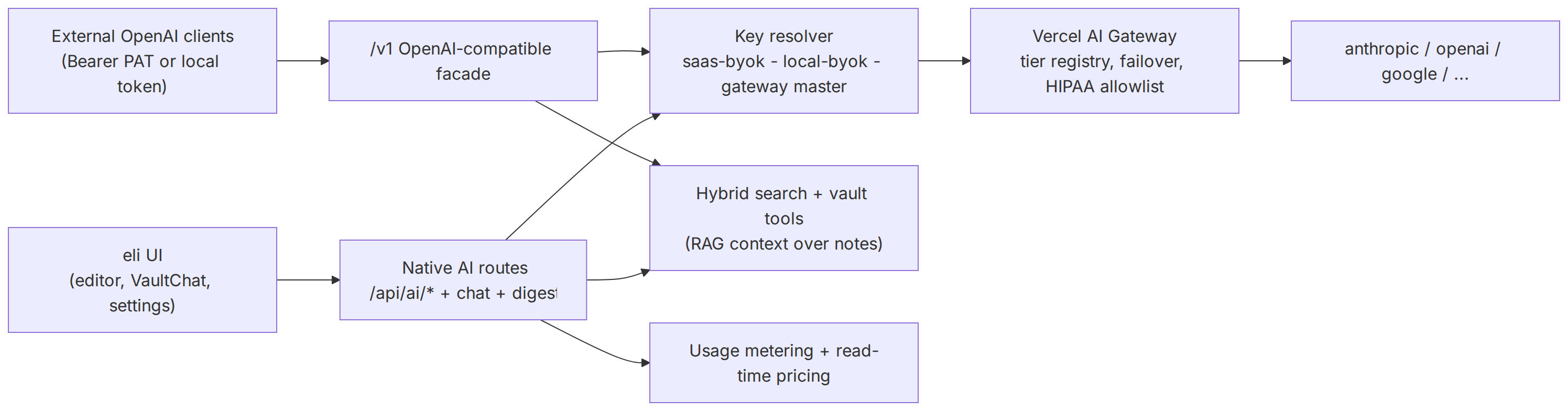
AI platform — simplified data flow
AI platform — simplified data flow maps the principal capabilities, boundaries, and data paths in this architecture.
Concepts
Keywords
+13 more
- Canonical
- Canonical: Source
- Mirrors
- None
Downloads


AI platform — simplified system view
AI platform — simplified system view maps the principal capabilities, boundaries, and data paths in this architecture.
Concepts
Keywords
+12 more
- Canonical
- Canonical: Source
- Mirrors
- None
Downloads

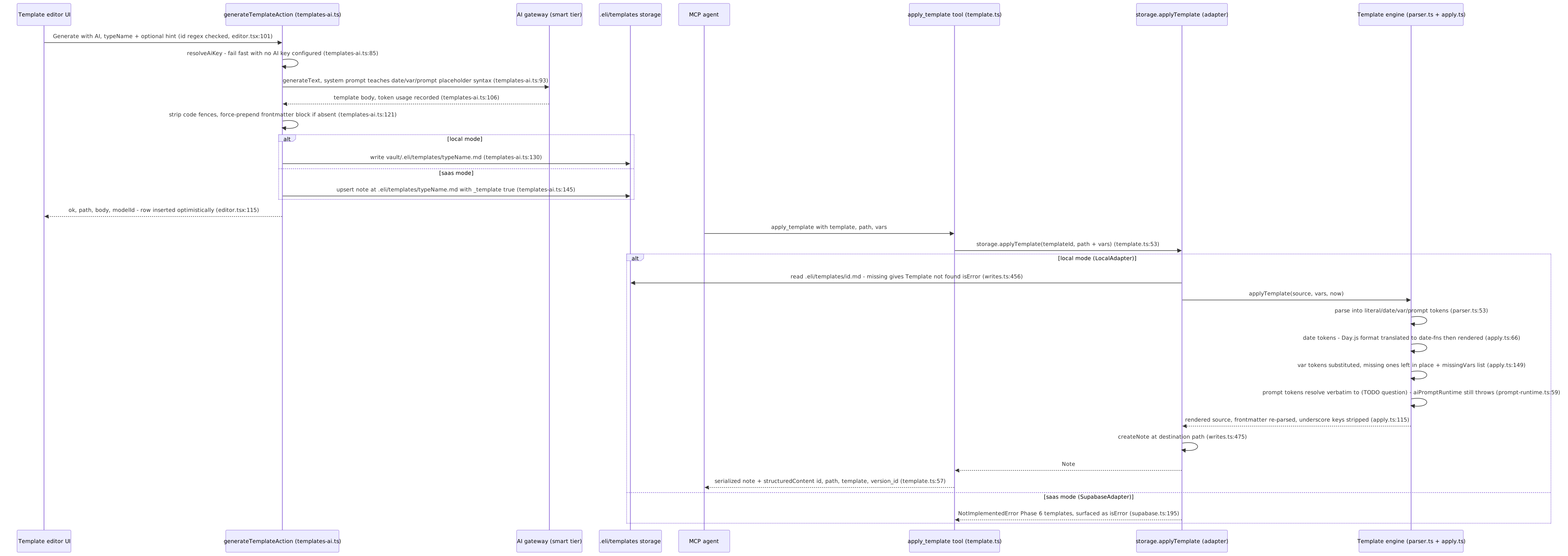
AI template generation
AI template generation traces the ordered service interactions, decisions, and persisted outcomes for this workflow.
Concepts
Keywords
+22 more
- Canonical
- Canonical: Source
- Mirrors
- None
Downloads
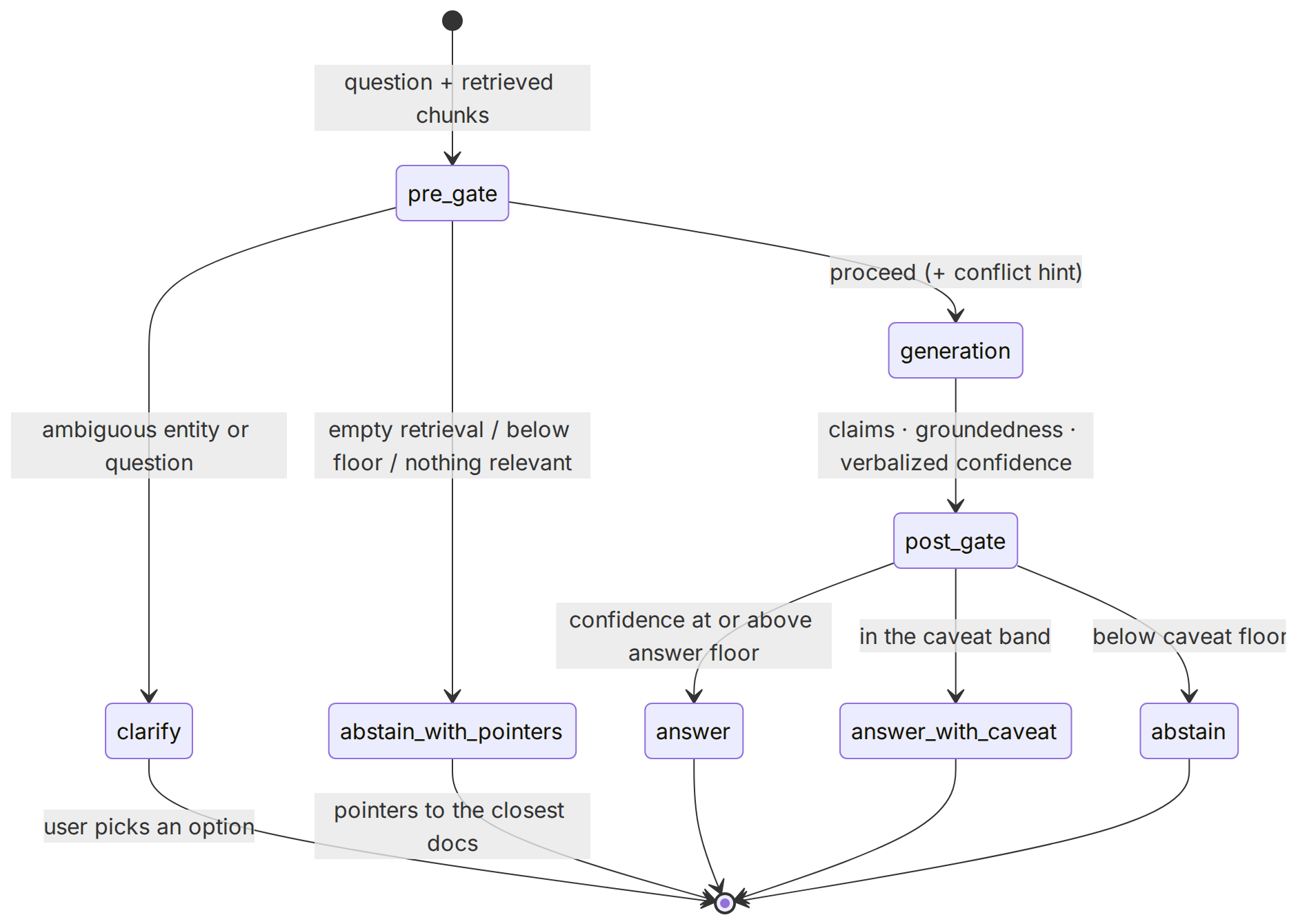
Answer-policy verdict lifecycle
The verdict flow. In enforce mode, clarify and abstain_with_pointers short-circuit generation entirely (a deterministic template answers, no model call); in shadow mode every verdict is computed and logged but behavior never changes.
Concepts
Keywords
+6 more
- Mirrors
- None
Downloads

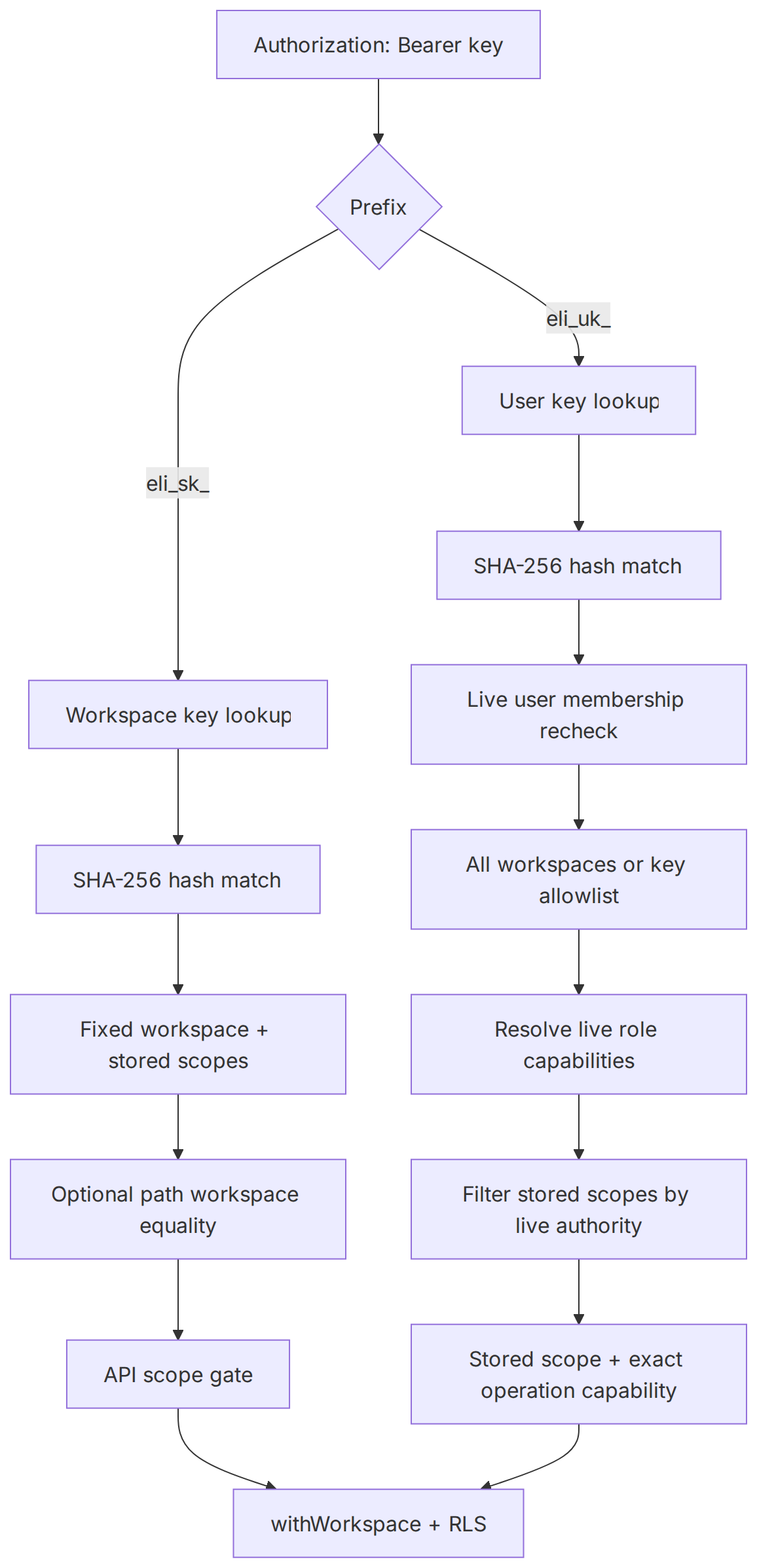
API-key paths: two different security models
API-key paths: two different security models maps the principal capabilities, boundaries, and data paths in this architecture.
Concepts
Keywords
+12 more
- Canonical
- Canonical: Source
- Mirrors
- None
Downloads

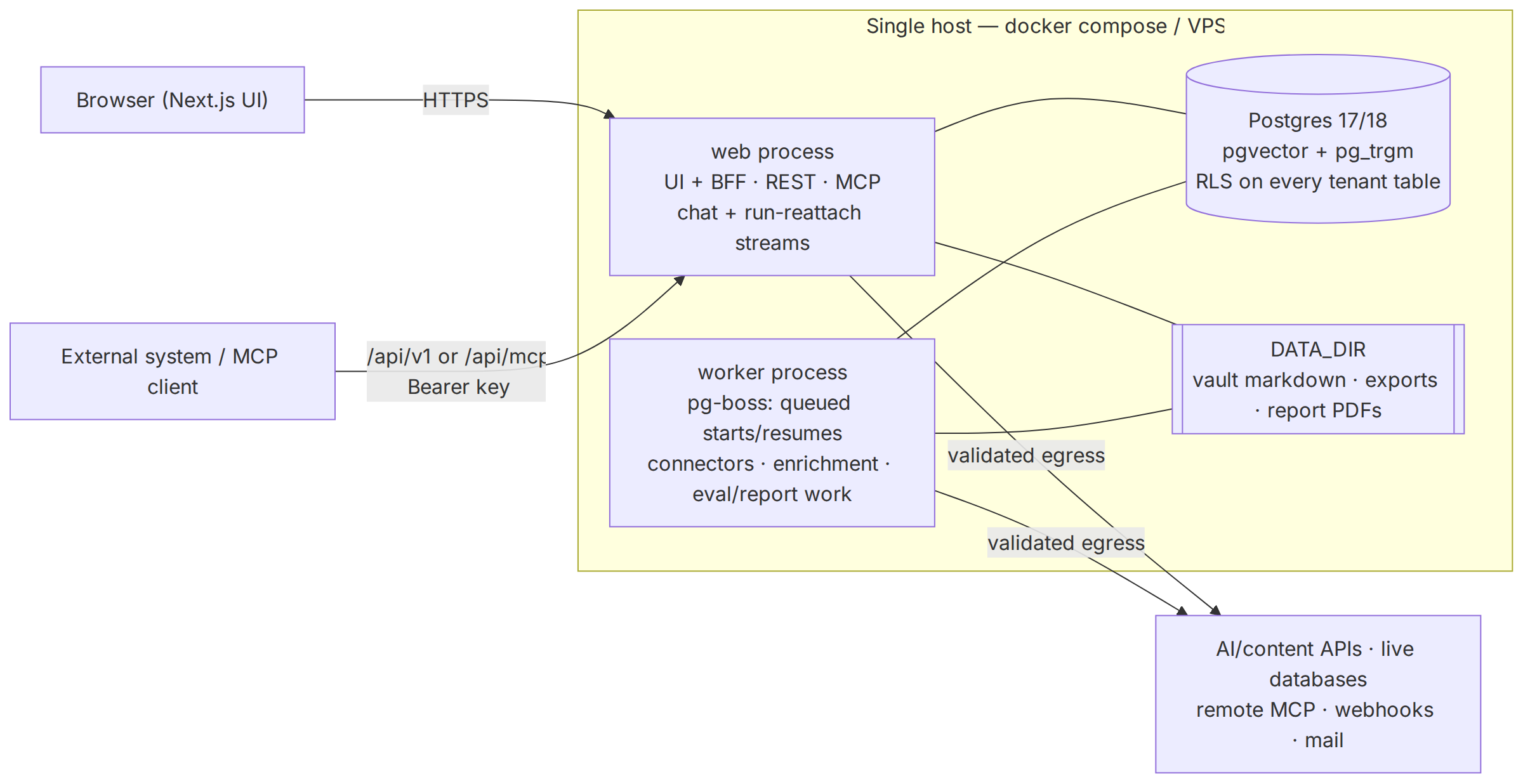
Application process topology
One host, two processes, one database, and outbound-only provider calls.
Concepts
Keywords
+19 more
- Mirrors
- Mirror: Source
Downloads

Provenance and metadata
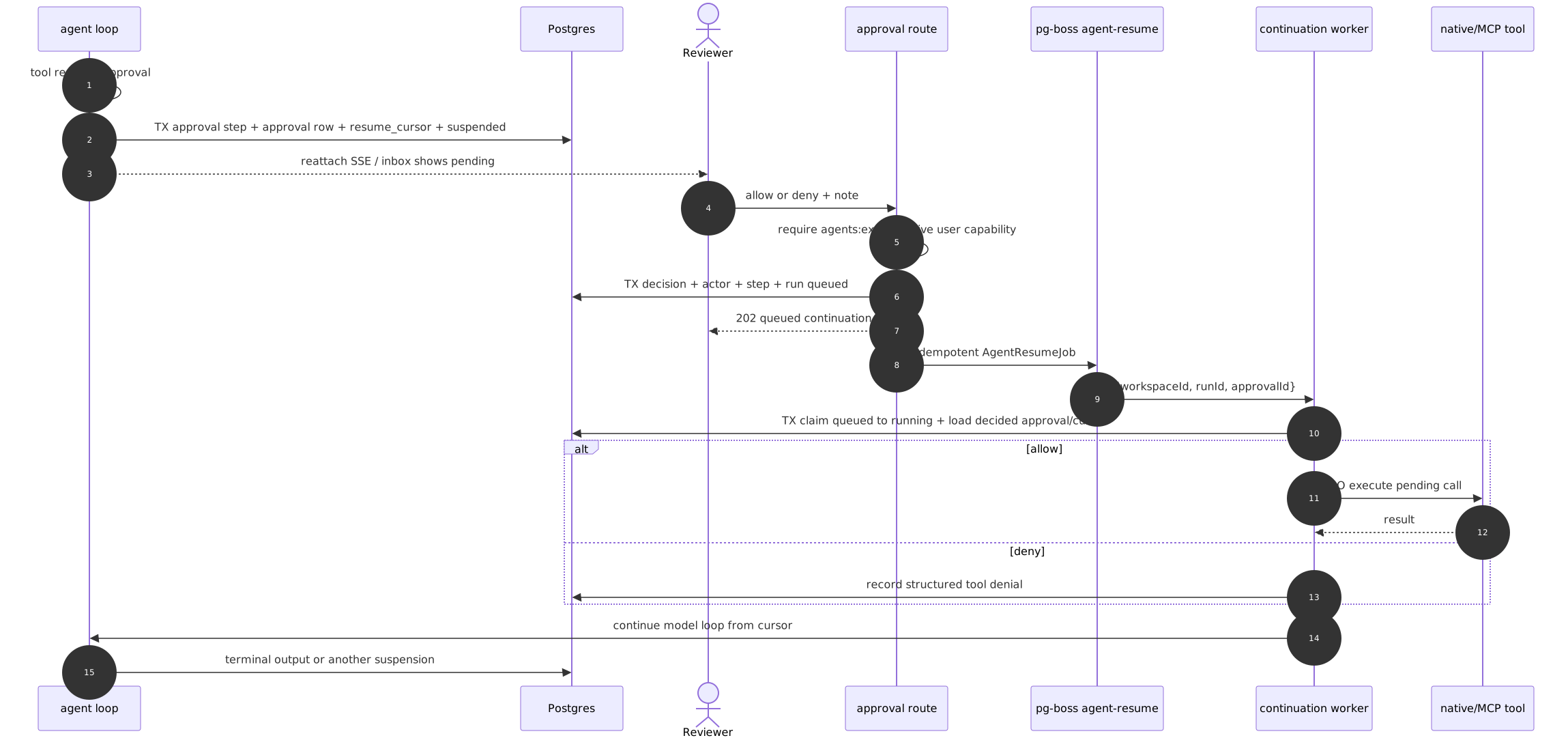
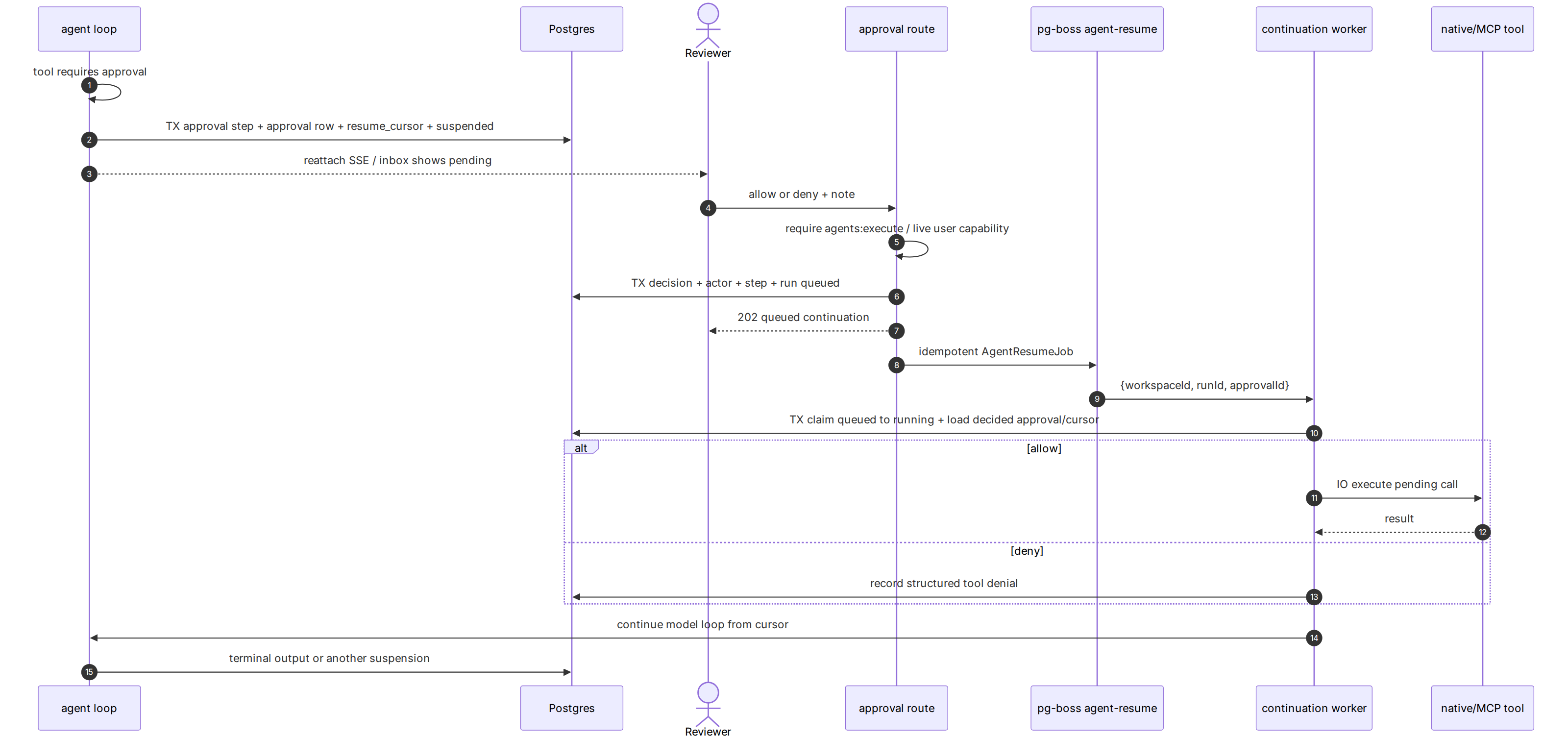
Approval and resume
Approval and resume traces the ordered service interactions, decisions, and persisted outcomes for this workflow.
Concepts
Keywords
+19 more
- Canonical
- Canonical: Source
- Mirrors
- None
Downloads
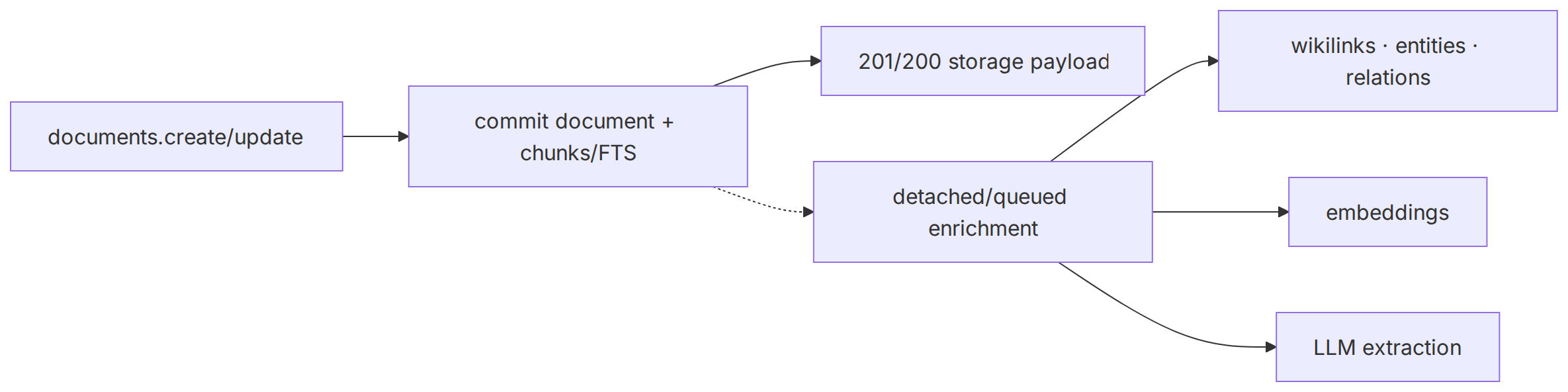
Asynchronous document lifecycle
Asynchronous document lifecycle maps the principal capabilities, boundaries, and data paths in this architecture.
Concepts
Keywords
+6 more
- Canonical
- Canonical: Source
- Mirrors
- None
Downloads

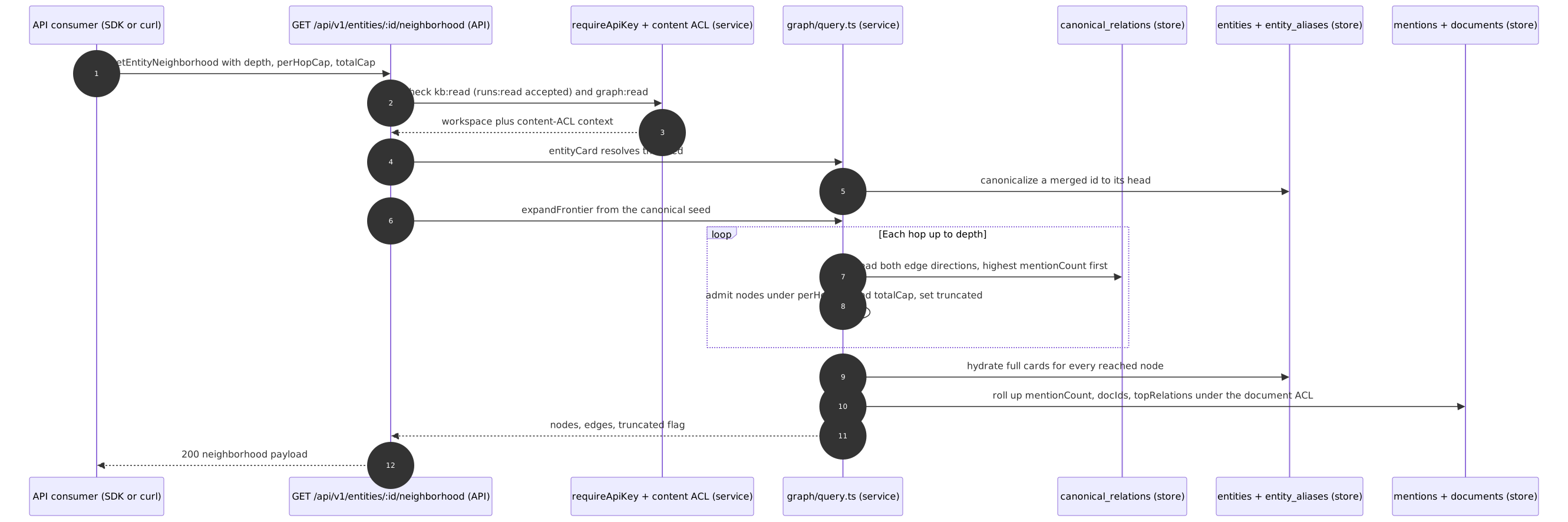
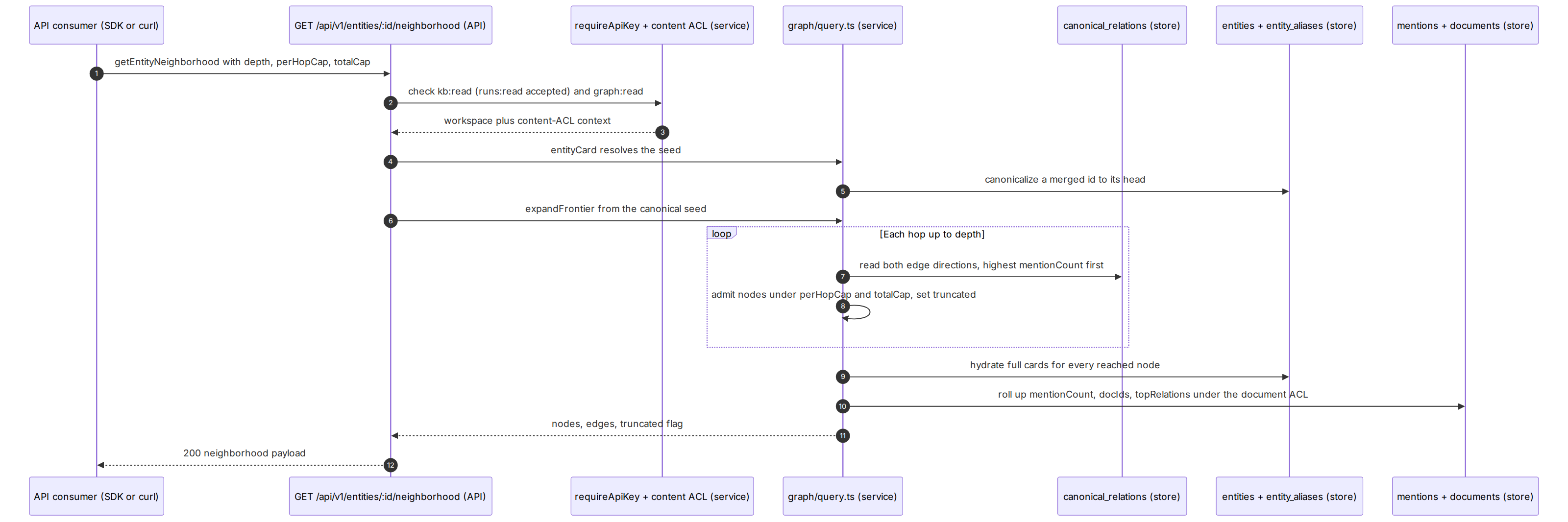
Atlas — primary runtime flow
getEntityNeighborhood canonicalizes the seed, expands the frontier hop by hop over canonical_relations taking highest-mention edges first, then hydrates full cards for every reached node under the document ACL.
Concepts
Keywords
+16 more
- Mirrors
- None
Downloads
Atlas — semantic graph
Evidenced deterministic links, atomic ontology-typed extraction, and human curation converge on canonical_relations.
Concepts
Keywords
+36 more
- Mirrors
- Mirror: Source
Downloads
Provenance and metadata
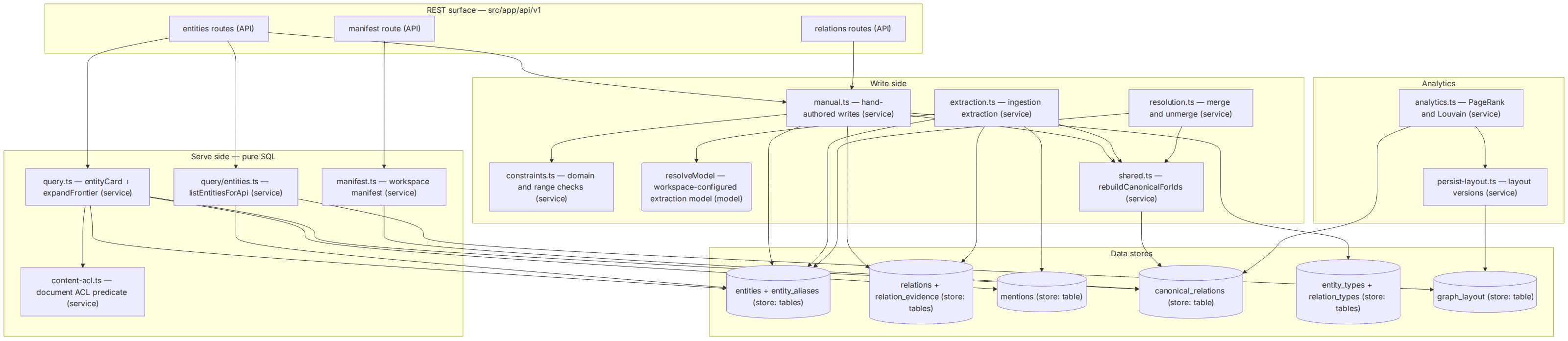
Atlas — system architecture
Writers (manual.ts, extraction.ts, resolution.ts) all converge on rebuildCanonicalForIds, which maintains canonical_relations — the only edge table the serve side reads. Analytics runs offline and persists PageRank into graph_layout, which the list read joins.
Concepts
+3 more
Keywords
+14 more
- Mirrors
- None
Downloads

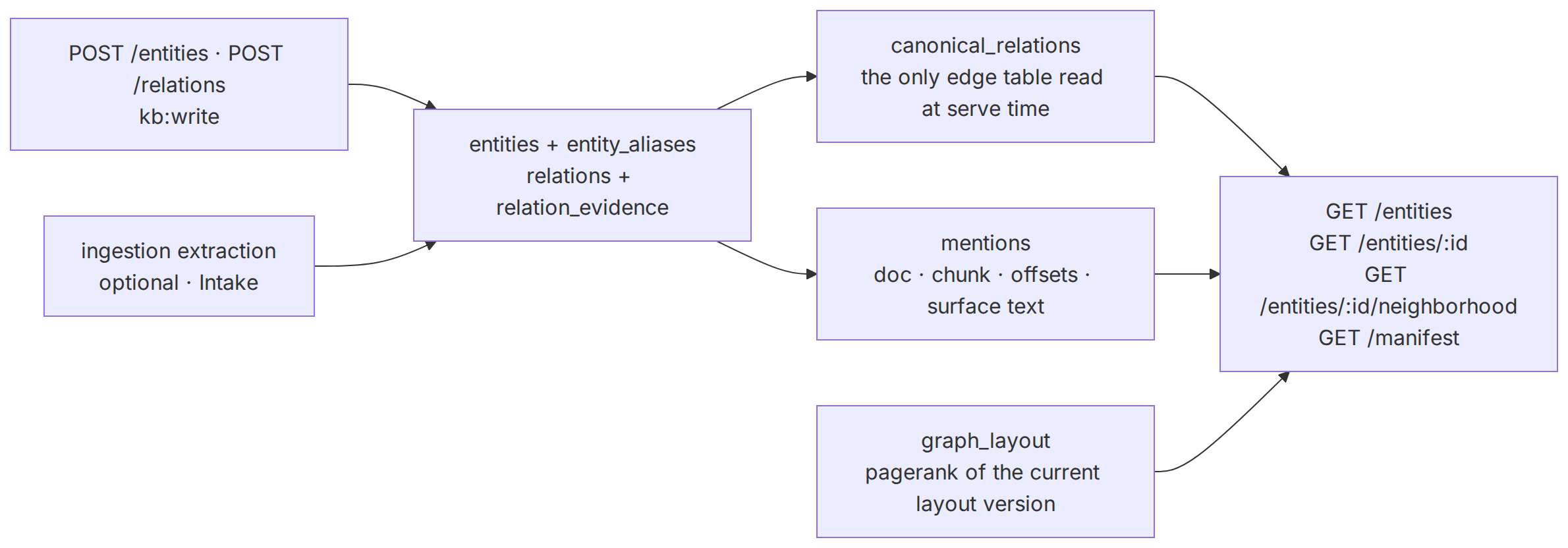
Atlas entity and relation lifecycle
Writes land on entities/relations (by hand, or from ingestion when Intake is present); reads are served from the canonical rollup plus the mention provenance. graph_layout supplies the pagerank on the list endpoint.
Concepts
Keywords
+12 more
- Mirrors
- None
Downloads

Authentication and workspace selection
Authentication and workspace selection maps the principal capabilities, boundaries, and data paths in this architecture.
Concepts
Keywords
+13 more
- Canonical
- Canonical: Source
- Mirrors
- None
Downloads


Authoring UX — detailed system view
Authoring UX — detailed system view maps the principal capabilities, boundaries, and data paths in this architecture.
Concepts
+7 more
Keywords
+36 more
- Canonical
- Canonical: Source
- Mirrors
- None
Downloads

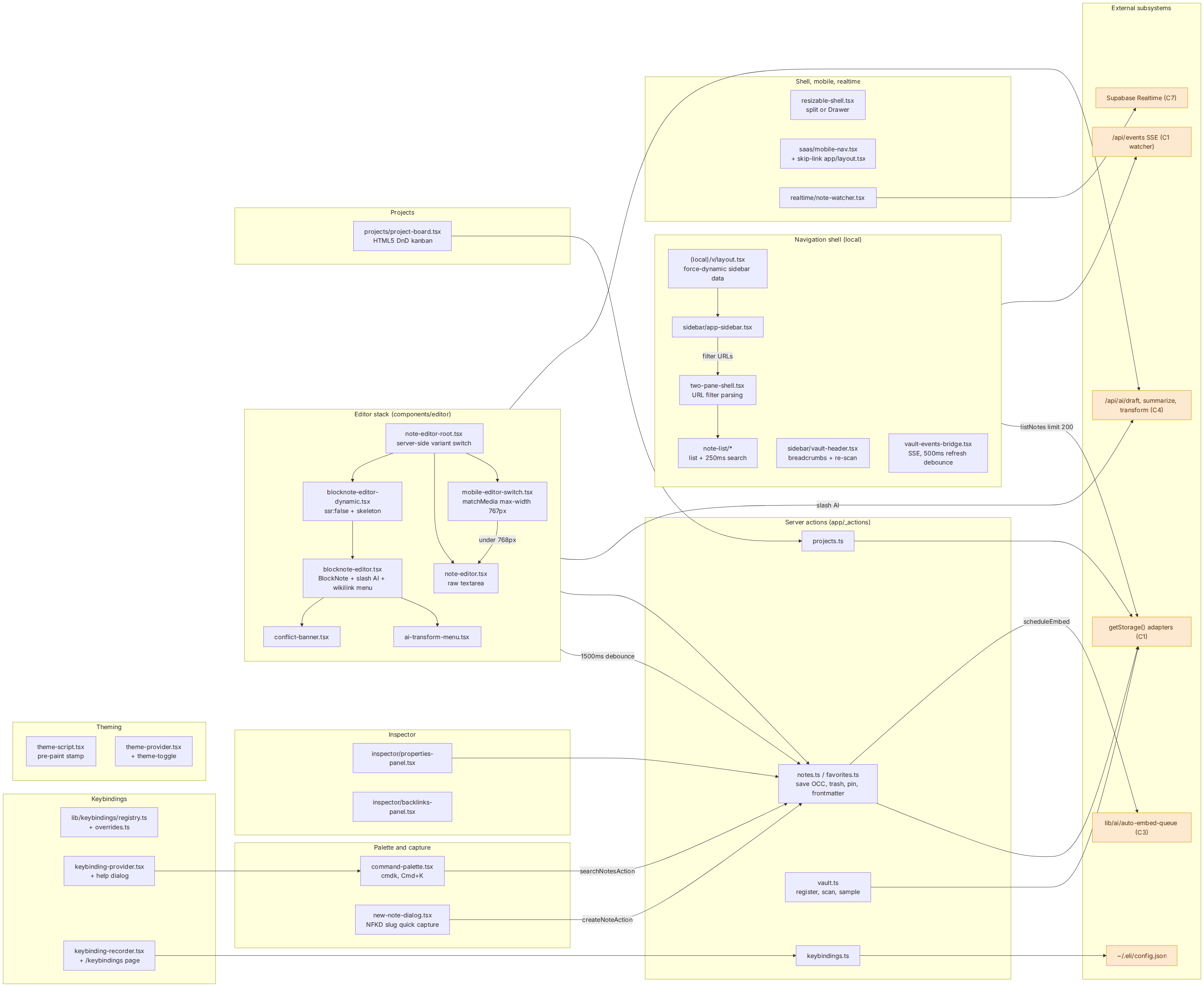
Authoring UX — simplified data flow
Authoring UX — simplified data flow maps the principal capabilities, boundaries, and data paths in this architecture.
Concepts
Keywords
+12 more
- Canonical
- Canonical: Source
- Mirrors
- None
Downloads


Authoring UX — simplified system view
Authoring UX — simplified system view maps the principal capabilities, boundaries, and data paths in this architecture.
Concepts
Keywords
+12 more
- Canonical
- Canonical: Source
- Mirrors
- None
Downloads


Authorized GraphRAG retrieval
Authorize before recall → retrieve → fuse and expand only through readable evidence → assemble → generate → verify.
Concepts
Keywords
+9 more
- Mirrors
- None
Downloads

