Crucible
Judge governance
An LLM judge grades groundedness across chat, agents, evals, and drift scans — so a judge that quietly drifts corrupts every quality signal downstream of it. Judge governance treats the judge as a measured instrument: it is calibrated against a human-labeled gold set, scored on agreement, false-positive, and false-negative rates, and only ever swapped through a shadow cutover that proves the new judge is better before it goes live.
The calibration gold set
The gold set is a curated collection of cases with human ground-truth labels— grounded vs. ungrounded claims, correct vs. incorrect verdicts — that represents what "right" means for this workspace. It is the fixed reference every judge is measured against. Because it is human-labeled and stable, it turns "is the judge good?" from an opinion into a measurement.
The gold set is the anchor
Agreement, FPR & FNR
Running a judge over the gold set and comparing to the human labels yields the metrics stored in judge_calibration:
- Agreement— how often the judge's verdict matches the human label. The headline number, but not the whole story.
- False-positive rate (FPR) — how often the judge calls something grounded that humans marked ungrounded. High FPR means the judge rubber-stamps hallucinations — the dangerous failure.
- False-negative rate (FNR) — how often the judge flags a claim that was actually grounded. High FNR means noise: it erodes trust and buries real regressions under false alarms.
FPR and FNR trade off, and the right balance is a policy choice. For a client-facing groundedness gate you usually weight low FPR most — never vouch for an unsupported claim — while tolerating some FNR. Reporting all three keeps that trade-off explicit instead of hidden inside a single accuracy number.
Shadow-judge cutover
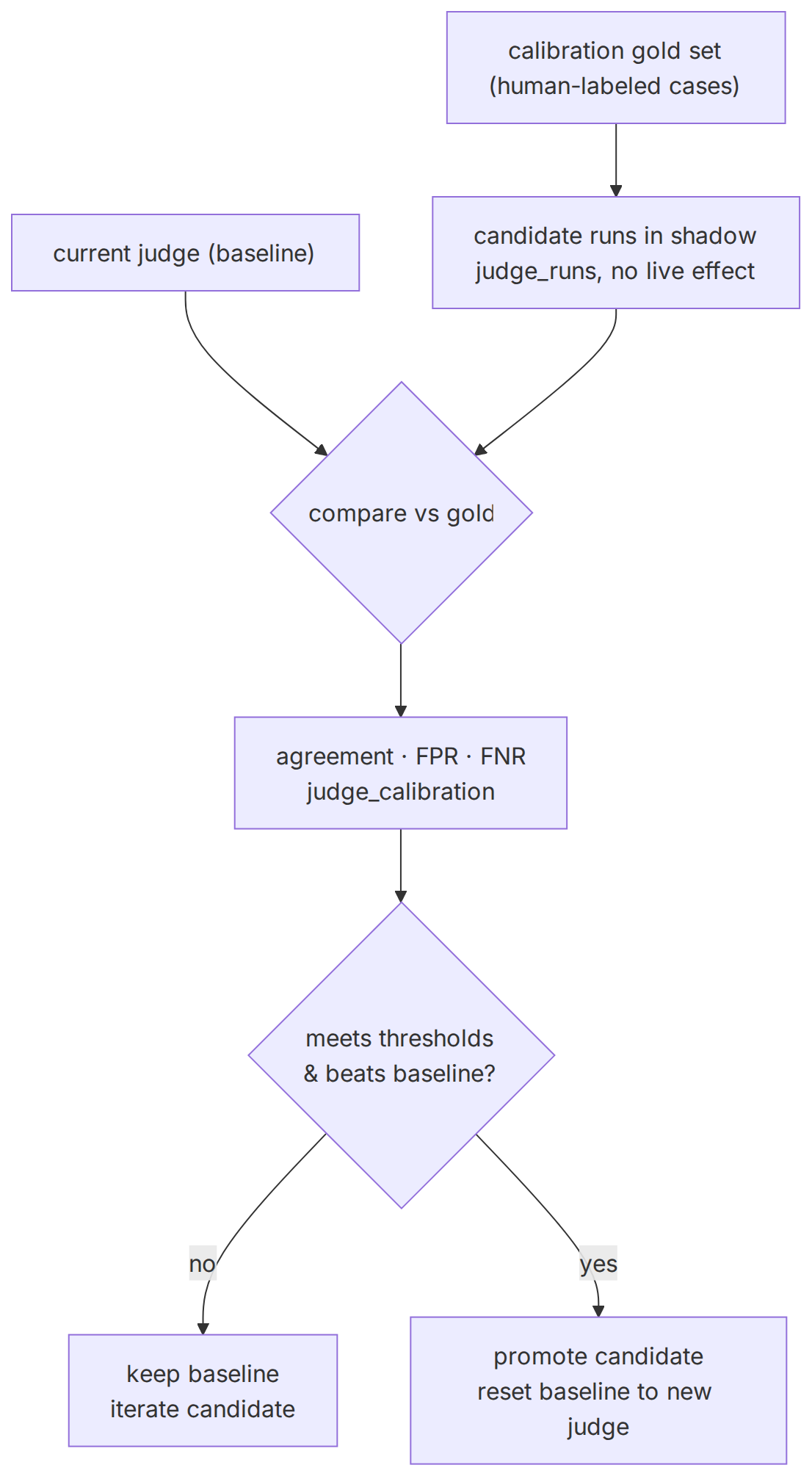
You never swap the live judge blind. A candidate judge — a new model, a new prompt — first runs in shadow: it grades real traffic and the gold set with results recorded to judge_runs, but with no live effect. Its metrics are compared against the current baseline, and it is promoted only if it clears the thresholds and beats the incumbent.
Judge model cutover
A measured judge cutover: shadow → compare against gold → gate → promote.
Downloads

Concepts
- Judge governance
- Cutover
Keywords
- judge_runs, no live effect
- calibration gold set
- human-labeled cases
- compare vs gold
- agreement · FPR · FNR
- meets thresholds
- & beats baseline?
- keep baseline
- iterate candidate
- promote candidate
- candidate runs in shadow
- current judge (baseline)
- reset baseline to new judge
- judge_calibration
- no
- yes
Source and generation provenance
Status: current
Generated at: 2026-08-12T23:39:42.906Z
Source hash: 4d5e0e78924122683a60c75dd665e8181caf7f9e821cebc7ec0dd9ef0313eb56
Metadata payload hash: 0ea1b35e4a4aabc90cbaddbef67f48ba9e4d2682cebf2323fcdf043e05aba9b8
Canonical appearance
src/app/(docs)/docs/concepts/judge-governance/page.tsx:25 route /docs/concepts/judge-governance
All appearances
canonical—src/app/(docs)/docs/concepts/judge-governance/page.tsx:25route/docs/concepts/judge-governance
No mirrored appearances.
Generation versions
App: eli-ai 0.1.0
Mermaid: 11.16.0 · Mermaid CLI: 11.16.0
Node: v26.3.1 · Yarn: 4.17.1
Renderer config hash: 68c10966fe84406ee626034d58bfabd555df9f65f691204b7c46db24038da101
Renderer theme hash: c80287a78d80ad63d27bd5ca348b2ef9a7e2f44da289e436be6484ea28a1b033
Adapter versions: diagramGenerator=2, drawioFlowchart=1, drawioGantt=1, drawioSequence=1, drawioState=1
Full sidecar JSON: judge-model-cutover-4d5e0e78.json
This makes a judge change a measured migration, not a leap of faith. If the candidate regresses on FPR, it stays in shadow and the baseline keeps serving — the live quality signal never degrades because someone tried a new prompt.
Baseline resets
When a candidate is promoted, the baseline resets to the new judge: subsequent calibration and drift comparisons measure against the new incumbent, so improvement is always relative to what is actually running. A baseline reset is a deliberate, recorded event — you can see when the judge changed and how the metrics moved across the cutover, which keeps drift-scan history honest across judge generations.
Governance closes the loop
Related
- Evals & drift — where the judge grades golden sets.
- Retrieval & grounded chat — the groundedness badge this judge produces.