Crucible
Evaluation framework
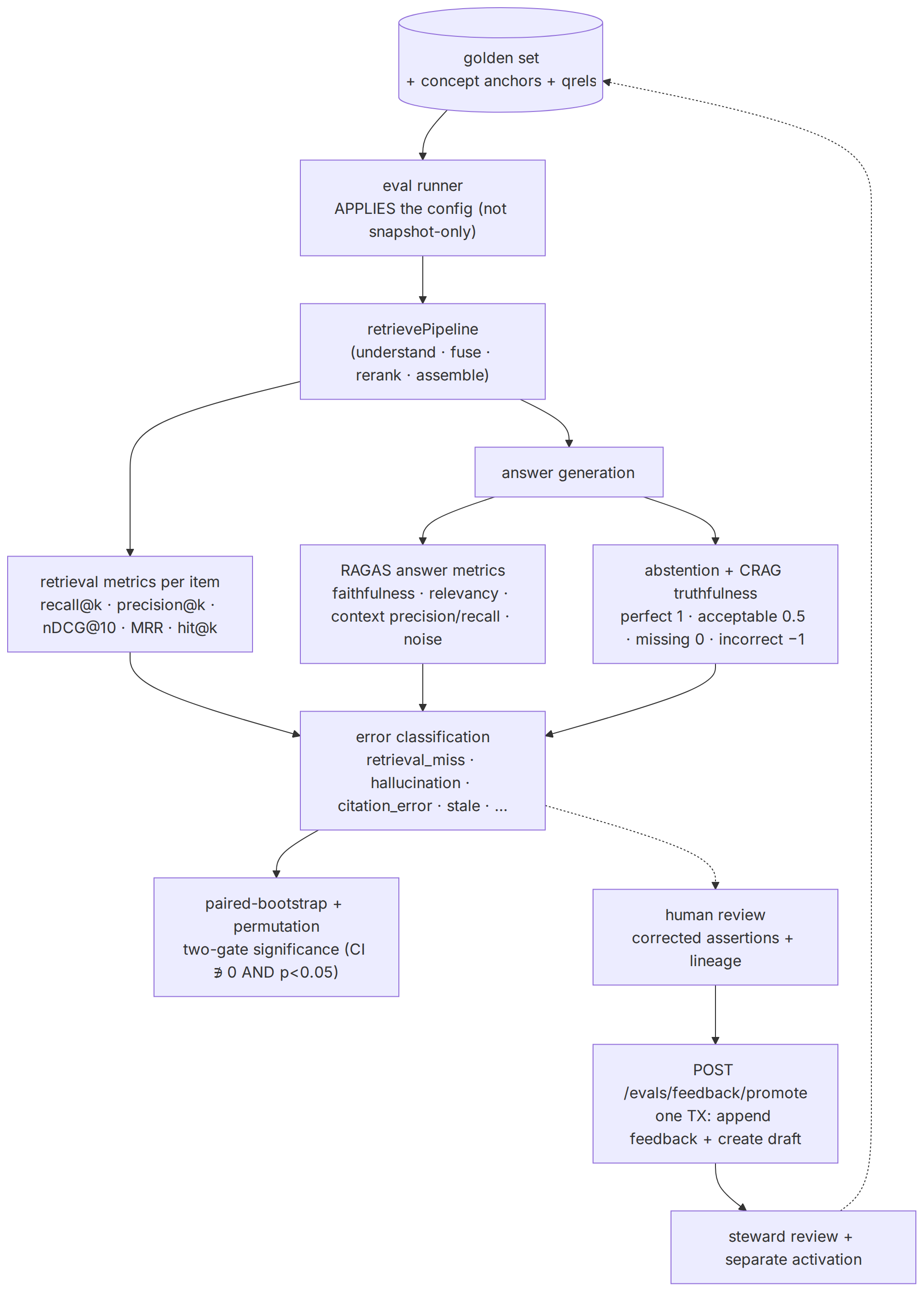
The first-generation evals model answered one question: did this answer's claims hold up? That is necessary but not sufficient. An answer can be perfectly faithful to the wrong chunks, or right by luck when retrieval missed the source it should have used. The evaluation framework separates the pipeline into layers it can measure independently — retrieval quality, answer quality, and abstention behavior — using the established RAG-evaluation literature, and it does so on a config the runner actually applies rather than merely records.
The one behavior change that unlocks everything else
evalConfigs.params carries the full pipeline config (retrieval stages, policyMode, promptVersion, retrievalLimit, chatModelSlot) and the runner routes retrieval through the real pipeline with those stages engaged. The default config is byte-for-byte the current behavior (retrieval limit 10, no rerank, policy off), so existing numbers never move unless a config opts in — that invariant is what makes A/B comparison honest.Three measurable layers
Evaluation framework — layers
One run, three families of metric. Retrieval is scored against graded relevance judgments; the answer is scored with RAGAS and CRAG; every failure is classified so the diff explains itself. Significance gates any claim of improvement.
Downloads

Concepts
- Evaluation framework
- Layers
Keywords
- eval runner
- answer generation
- RAGAS answer metrics
- error classification
- APPLIES the config (not snapshot-only)
- understand · fuse · rerank · assemble
- retrieval metrics per item
- faithfulness · relevancy · context · noise
- abstention + CRAG truthfulness
- one TX: append feedback + create draft
- steward review + separate activation
- precision/recall
- /evals/feedback/promote
- retrievePipeline
- perfect 1 · acceptable 0.5 · missing 0 · incorrect −1
- retrieval_miss · hallucination · citation_error · stale · …
- POST
- recall@k · precision@k · nDCG@10 · MRR · hit@k
Source and generation provenance
Status: current
Generated at: 2026-08-12T23:38:39.196Z
Source hash: 0156cf52621e40fc47164e9f754fa644d27bc03009839e65f2e45add9c2ddc2c
Metadata payload hash: 7a6f02964cc85981d79555735820a230f63ee012fe28d4d1ef7f5c5e7b85db9b
Canonical appearance
src/app/(docs)/docs/concepts/evaluation-framework/page.tsx:32 route /docs/concepts/evaluation-framework
All appearances
canonical—src/app/(docs)/docs/concepts/evaluation-framework/page.tsx:32route/docs/concepts/evaluation-framework
No mirrored appearances.
Generation versions
App: eli-ai 0.1.0
Mermaid: 11.16.0 · Mermaid CLI: 11.16.0
Node: v26.3.1 · Yarn: 4.17.1
Renderer config hash: 68c10966fe84406ee626034d58bfabd555df9f65f691204b7c46db24038da101
Renderer theme hash: c80287a78d80ad63d27bd5ca348b2ef9a7e2f44da289e436be6484ea28a1b033
Adapter versions: diagramGenerator=2, drawioFlowchart=1, drawioGantt=1, drawioSequence=1, drawioState=1
Full sidecar JSON: evaluation-framework-layers-0156cf52.json
Each family answers a different failure mode. Read them together and you can attribute a regression to its cause instead of guessing:
- Retrieval metrics — did the pipeline surface the right evidence, and rank it well? Covered in depth in Retrieval metrics.
- Answer metrics (RAGAS) — given what it retrieved, is the answer faithful, relevant, and well-supported?
- Abstention & truthfulness (CRAG) — did it answer when it should have, and stay silent when it should not have guessed?
Concept anchoring: what "relevant" means
A golden item no longer anchors only to documents. It anchors to concepts — the entities an answer must be grounded in. The golden_concepts table binds an item to entity ids with a relevance grade: required (the answer is wrong without it), acceptable (helpful, not mandatory), or irrelevant (a near-miss the retriever should not pull). A must/should assertion can name a conceptIdit depends on, so the runner scores "did the pipeline actually detect the entity this claim needs" — not just "did the prose look right." This is the difference between an eval that rewards a lucky paraphrase and one that rewards genuine grounding.
Graded relevance & qrels
Retrieval IR metrics need a relevance judgment per (query, chunk) pair — the qrels of the TREC tradition. The qrels table stores graded judgments (grade 0–3: irrelevant → perfectly relevant) with a source stamp:
provenance— free and deterministic: a golden item's anchored citations are the highest-grade judgments, derived without a model.llm— a graded-relevance judge (UMBRELA-style, below) labels the rest of the retrieved pool, stamping itsjudge_modelandprompt_version. Verdicts are cached back intoqrelsso a re-run is free and reproducible.human— an override appends a new row, never mutates. The table is append-only; the unique key is(query, chunk, source, judge_model)so a human correction and the LLM judgment it disputes both survive, auditable side by side.
UMBRELA — a reproducible relevance assessor
0–3 grade, the model id recorded. It is a judge, so it is non-deterministic — which is exactly why its verdicts are cached to qrels and pinned to a prompt version: two runs judged by different judges are never compared.Answer metrics: RAGAS, ported
The answer layer ports the RAGASmetric definitions onto the platform's existing batched judge (the same judgeAssertions engine that powers grounded chat — reused, never forked), each storing its judge_model and prompt_version:
- Faithfulness— the fraction of the answer's claims entailed by the retrieved context. The direct measure of hallucination.
- Response relevancy — how well the answer addresses the actual question (RAGAS estimates this by generating questions the answer would answer and comparing them to the original).
- Context precision — are the relevant chunks ranked at the top of what was retrieved? A precision-at-rank signal on the context itself.
- Context recall — did retrieval surface everything the reference answer needed?
- Noise sensitivity — how often an irrelevant retrieved chunk corrupts a claim. RAGAS added this precisely because a high-faithfulness answer can still be led astray by a plausible distractor.
Abstention & CRAG truthfulness
A RAG system that never abstains will confidently answer questions its corpus cannot support. The CRAG benchmark formalized the scoring that makes silence measurable — and makes a wrong answer cost more than no answer:
The runner designates each result abstained or not, computes truthfulness via one judge call, and pairs it with a risk–coverage curve and its summary AURC (area under the risk–coverage curve) over {confidence, correct} pairs — the same selective-prediction lens the answer policy uses to pick its floors, now measured on the golden set. A workspace can read exactly how much coverage it buys per point of risk before it trusts the pipeline to abstain in production.
Golden items carry the CRAG facets too — answerable (is the corpus expected to support this at all?), questionType (simple · conditional · set · comparison · aggregation · multi_hop · post_processing · false_premise), popularity (head/torso/tail), and dynamism (static/slow/fast) — so metrics break down by question difficulty and by how fast the truth moves, not just by business unit. A false_premise item is a trap: the correct behavior is to reject the premise, and abstention scoring is what lets you reward that.
Error classification
Every result is labeled with one errorClass, turning a bag of failures into a diagnosable distribution written to the append-only eval_feedback queue:
retrieval_miss— the evidence was never retrieved. Fix the corpus or the retriever, not the prompt.hallucination— a claim with no support in what was retrieved.citation_error— right claim, wrong or missing[Sn]marker.stale— grounded in an out-of-date source (thedynamismfacet is what makes this detectable).incomplete— a must-assertion missing, though what was said is correct.conflict_mishandled— sources disagreed and the answer picked one silently instead of surfacing both.correct— the happy path.
Because the queue is append-only and content corrections travel with it, a classified failure can be promoted back into a golden item — the loop that turns a caught regression into a permanent test.
Promote a reviewed correction
A reviewer can turn a corrected eval result into a regression test with POST /api/w/:workspaceId/evals/feedback/promote. This path takes assertions the reviewer has already corrected; it does not call a model. It first verifies that the run belongs to the workspace and, when supplied, that resultId belongs to that run. It then uses one workspace transaction to create the draft golden item and its must-assertions, citation anchors, and tags, while appending the linked eval_feedback audit row. A validation or write failure rolls back both sides.
/api/w/:workspaceId/evals/feedback/promoteSession · evals:writePromote human-reviewed corrected assertions from an eval run into a draft golden item and append its lineage feedback atomically. Returns 201 with both records.
Request body
Lineage errors never partially promote
404 {"error":"run-not-found"}; a missing result returns 404 {"error":"result-not-found"}. If the result exists but belongs to another run, the route returns 409 {"error":"result-run-mismatch"}. These checks and both inserts share the same transaction, so none of these failures leaves a golden item or feedback row.Correction promotion is not answer decomposition
POST /api/w/:workspaceId/golden/promote takes a supplied answerText and asks the judge model to decompose it into candidate assertions; it does not read or append eval_feedback. Reviewed correction promotion takes the human-supplied correctedAssertions, preserves run/result lineage, and performs no provider call. Both paths return a draft. A steward must review it and separately activate it with PATCH /api/w/:workspaceId/golden/:id and {"status":"active"}; neither promotion route auto-activates.Component vs. system
The runner can execute in two modes. System mode runs the full answer pipeline and scores the end product. Component mode runs retrieval only, scoring recall/nDCG against the qrels without spending generation tokens — so you can tune the retriever in a fast, cheap loop and only run the expensive full-system eval once retrieval is where you want it. It is the same distinction a search team draws between offline IR evaluation and end-to-end evaluation, made a first turn of the dial rather than a fork of the harness.
Significance: two gates, seeded
A golden set is small, so a raw "+3 points" means nothing without a significance test. Comparison runs a paired bootstrap with BCa (bias-corrected and accelerated) confidence intervals and a paired permutation test, both seeded and deterministic (a mulberry32 PRNG — the same seedable generator the confidence model uses), and it only calls a difference real when both gates pass: the CI excludes 0 and p < 0.05. Two independent tests agreeing is a deliberately conservative bar — it is designed to refuse to cry "improvement" on noise, the single most common way an eval product lies to its owner.
Determinism is the contract
Research grounding
None of these metrics is invented here — each maps to a published benchmark or an established IR definition, which is what lets the numbers be compared to the outside world:
| Mechanism | Where it lives | Research grounding |
|---|---|---|
| Faithfulness · relevancy · context P/R · noise | metrics/ragas.ts | RAGAS (Es et al., 2023) — reference-free RAG metrics; noise sensitivity added for distractor robustness. Apache-2.0. |
| Graded relevance judge (0–3, cached to qrels) | metrics/umbrela.ts | UMBRELA (Upadhyay et al., 2024) — open reproduction of Bing's LLM relevance assessor; reproduces human TREC labels. |
| Truthfulness (+1/+0.5/0/−1) · abstention | metrics/abstention.ts | CRAG (Meta, NeurIPS 2024) — a hallucination is scored strictly worse than an honest 'missing'. |
| Question facets (type · popularity · dynamism · answerable) | golden_items columns | CRAG taxonomy — simple/set/comparison/aggregation/multi-hop/false-premise; head/torso/tail; static/slow/fast. |
| nDCG@10 with exponential gain 2^rel−1 | metrics/retrieval.ts | Järvelin & Kekäläinen DCG with the exponential-gain form used by TREC/LETOR — see Retrieval metrics. |
| Paired bootstrap (BCa) + permutation, two-gate | metrics/significance.ts | Standard IR significance testing; seeded PRNG for reproducibility; CI-excludes-0 AND p<0.05 to resist false positives. |
| Config applied + content-snapshotted | runner.ts + evalConfigs.params | Fixes the classic offline-eval fallacy — you must measure the pipeline you ship, with the stages it ships with. |
Put it to work